Why Hiring Specialized Chain Link Fence Contractors Makes All the Difference in Houston
When you search for chain link fence contractors near me in Houston, you’ll encounter a wide range of options — from established commercial fencing companies to general handymen and landscapers who occasionally install chain link as a side job. The difference between these options isn’t just price. It’s the difference between a fence that passes inspection, holds up through Houston’s brutal weather cycles, and stands for 20+ years — versus one that leans, sags, and fails within a few years. At Griffin Fence, we’ve been exclusively focused on fencing in the Houston area for over 25 years. This guide explains what separates real chain link fence contractors from the rest, what to verify before signing any contract, and why specialized expertise matters for every application from residential backyards to industrial perimeters.
- Specialized chain link contractors have the right equipment — commercial post drivers, hydraulic augers, proper fence stretchers — that general handymen lack
- Chain link installation requires specific knowledge of gauge, coating, hardware, and tension techniques that only come with dedicated experience
- Commercial chain link work requires understanding of ASTM specifications, local building codes, and permit requirements
- Houston’s clay soil and coastal humidity demand installation techniques that only locally experienced contractors have mastered
- Griffin Fence is a dedicated fencing company — this is all we do, and we’ve been doing it in Houston since 1993
General Handyman vs Specialized Chain Link Contractor: The Real Difference
The most common mistake Houston property owners make when hiring for chain link installation is treating it like a general carpentry or landscaping job. Chain link installation looks deceptively simple — how hard can it be to stick posts in the ground and wrap wire around them? The reality is that a chain link fence installed incorrectly fails in ways that are both expensive to fix and sometimes dangerous, particularly on commercial and industrial properties where perimeter security is a genuine liability issue.
Equipment Matters More Than You Think
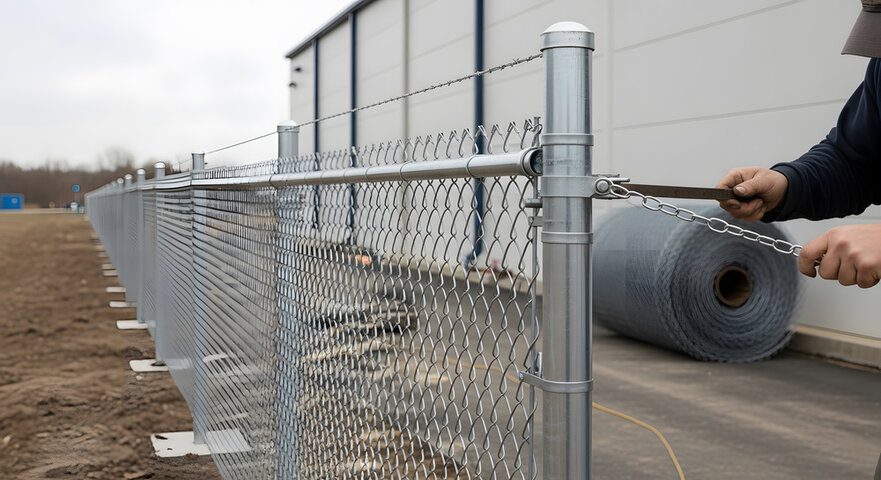
Professional chain link fence installation requires specific equipment that general contractors simply don’t own or know how to operate. The most critical piece is the fence stretcher — a mechanical assembly using a pull-bar and come-along (or dedicated fence stretcher tool) that applies consistent, measured tension to the chain link fabric as it’s secured to the terminal posts. Under-tensioned chain link fabric sags between posts in a visible wave pattern. Over-tensioned fabric can bow posts inward or pull fittings loose. Getting the tension right is a skill developed through hundreds of installations, and it requires the right tool.
Hydraulic post drivers are another key differentiator. Setting line posts by hand-driving steel into Houston’s notoriously hard clay soil (particularly after dry spells when the clay contracts to near-concrete hardness) is exhausting and often results in posts that aren’t fully seated or are driven out of plumb. A hydraulic or pneumatic post driver seats posts consistently, quickly, and accurately, which translates directly to a straighter fence line. For commercial projects requiring deeper footings, a truck-mounted hydraulic auger is essential — no hand auger can consistently bore 36–42-inch holes in Houston Black Clay.
Technical Knowledge of Chain Link Specifications
A genuine chain link contractor knows ASTM F668 (specification for PVC-coated chain link fabric), ASTM F1043 (specification for posts and hardware), and the appropriate gauge, mesh size, and coating class for each application type. When you ask a professional contractor what gauge they’ll use, they answer immediately and know why. When you ask a handyman, you often get a vague answer about “standard” chain link that may mean anything from 11-gauge (inadequate for most applications) to 9-gauge (residential standard) without any real specification. This matters because inferior gauge is invisible once installed — you cannot tell 11-gauge from 9-gauge by looking at a finished fence — and the failure mode doesn’t appear until the fence is 3–5 years old and starting to sag.
- Fence stretchers and come-alongs are specialized tools — proper tension requires both the right tool and the skill to use it
- Hydraulic post drivers produce straighter, more consistent results than hand-driving, especially in Houston clay
- Gauge fraud is common — always get gauge specification in writing and verify with a contractor who knows the difference
- Commercial post drivers and truck-mounted augers are major capital investments — only dedicated fence companies make them
- Ask any contractor about ASTM F668 and F1043 — a real chain link professional will know these specifications immediately
What to Verify Before Hiring a Chain Link Fence Contractor in Houston
Whether you’re getting quotes for a residential backyard or a 500-foot commercial perimeter, there are specific items you should verify with every contractor before signing a contract. Skipping these steps has cost many Houston property owners significant money in fence remediation and legal fees.
Insurance: General Liability and Workers’ Compensation
This is non-negotiable. Ask every contractor to provide certificates of insurance showing general liability coverage (minimum $1 million per occurrence for residential work, $2 million for commercial) and workers’ compensation insurance. Workers’ comp is particularly important: if an uninsured worker is injured on your property, you may face liability as the property owner. Texas does not require employers to carry workers’ comp, which means a surprising number of fence installers in Houston operate without it. Don’t take their word for it — request the actual certificate and verify the policy hasn’t lapsed by calling the insurer. Griffin Fence carries full general liability and workers’ compensation insurance and provides certificates on request.
Licensing and Registration
Texas does not have a specific state license for fence contractors, but reputable companies are registered with the Texas Secretary of State as legitimate business entities, carry required contractor registrations in municipalities that mandate them, and are members of industry associations. Look up any contractor on the Better Business Bureau website and Google Reviews. A company with 10+ years in Houston and 4+ stars on Google with multiple reviews is demonstrably more trustworthy than a three-year-old company with no reviews or a pattern of negative reviews citing incomplete work or disappeared contractors.
Written Specifications in the Contract
Your contract should specify, at minimum: the wire gauge (e.g., “9-gauge galvanized fabric ASTM F668 Class 1”), post size (e.g., “2-3/8″ schedule 40 line posts, 2-7/8″ terminal posts”), post spacing (every 10 feet for residential), footing depth (minimum depth in inches), footing diameter, gate dimensions and hardware specifications, and coating type (galvanized or vinyl-coated, including coating class). If a contractor refuses to put these specifications in writing, or gives you a contract that just says “chain link fence, 6 ft, $X” without any material specifications, walk away. You’re inviting a dispute about what was actually delivered.
Permits and Code Compliance
Ask specifically: “Will you pull the permit for this installation?” A legitimate fence contractor handles permit applications as part of the job. If a contractor tells you that permits “aren’t necessary” for work that clearly requires them — commercial installations, fences over 6 feet in Houston, any installation in a municipality with known permit requirements — they’re either uninformed or hoping to avoid the cost and scheduling delay of proper permitting. Either way, you’re the property owner who faces code enforcement action if the fence doesn’t meet requirements. Our team researches permit requirements for every job and handles all applications before work begins.
- Request certificates of insurance for general liability and workers’ comp — verify with the insurer that the policy is current
- Check BBB rating and Google Reviews for at least a 3-year track record
- Insist on written material specifications: gauge, post size, footing depth, and coating class
- Any commercial installation over 6 feet requires permits — a contractor who says otherwise is a red flag
- Griffin Fence provides all specifications in writing and handles all permit applications on every applicable job
Griffin Fence Commercial Chain Link Capabilities in Houston
Our commercial chain link work spans the full spectrum of Houston’s industrial and institutional landscape. Understanding our capabilities helps you determine whether we’re the right fit for your specific project.
Warehouses and Distribution Centers
Houston’s I-10 East corridor, the Beltway 8 industrial loop, and the Ship Channel area contain hundreds of warehouses and distribution centers that require serious perimeter fencing. We regularly install 8-foot and 10-foot 6-gauge galvanized chain link with three-strand barbed wire for these facilities. Typical warehouse perimeter projects range from 500 to 2,000+ linear feet. We coordinate with site managers and general contractors on construction phasing, schedule around peak receiving and shipping windows, and provide required submittals and material certifications for general contractor packages. Our commercial team handles the full scope of a warehouse perimeter installation — layout, post setting, fabric, gates, barbed wire, security additions, and final inspection coordination.
Construction Sites
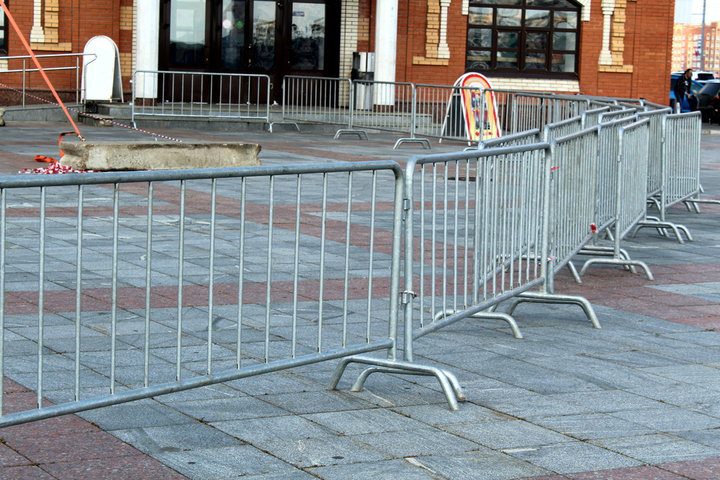
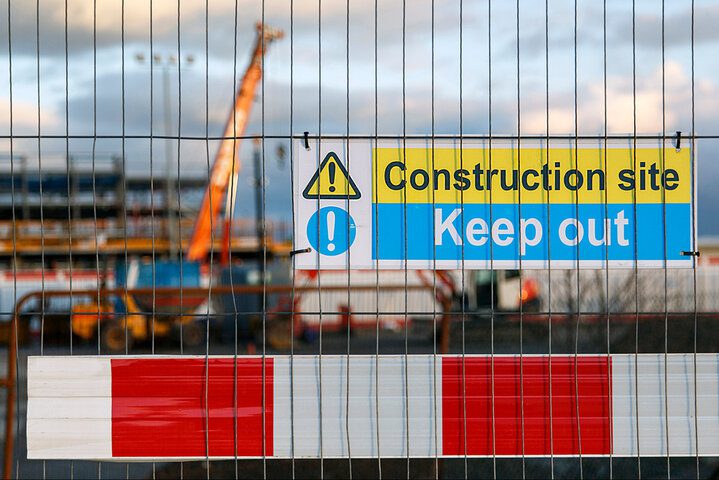
Construction site fencing in Houston serves dual purposes: OSHA-required site security and required pedestrian protection. Construction site chain link is typically 6-foot 9-gauge galvanized with wind screens or privacy fabric on street-facing elevations. We install both temporary (rented) and permanent (purchased) construction site fencing. Temporary installations use weighted or driven portable posts with chain link panels. Permanent installations are post-and-concrete construction using the same methods as any other commercial chain link. For large construction projects with phased site access needs, we work with project managers to plan fence line modifications in advance. See our commercial fence company page for more information on our construction site fencing capabilities.
Schools and Educational Facilities
School perimeter fencing in Houston typically requires 6-gauge chain link to meet HISD and Texas Education Agency facility standards. The heightened durability requirement reflects both security needs and the practical reality that school perimeter fences are subjected to constant physical contact from students. We’ve installed fencing at numerous HISD campuses, charter schools, and university facilities in the Houston area. School installations require close coordination around the academic calendar, and we’re experienced with working around active campuses during limited-access windows.
Parks and Recreation Facilities
Chain link is the standard for parks, athletic fields, and recreation areas across Houston and Harris County. Dugout fencing, backstop structures, batting cage enclosures, and park perimeter chain link all require specific knowledge of park-grade specifications. Backstops and dugouts involve non-standard geometry and require experienced fabricators. We’ve built backstops and athletic facility fencing for both municipal parks and private athletic facilities throughout the Houston metro area. For dog parks and dog run enclosures, we install heavy-duty chain link with bottom tension wire and self-closing gates to meet typical municipal dog park specifications.
Industrial and Energy Sector
Houston’s petrochemical industry along the Ship Channel and Highway 225 corridor has some of the most demanding perimeter security requirements of any industry. We’re familiar with the requirements of industrial sites, including Class 1 Division 1 and Division 2 electrical hazardous areas (which affect what equipment can be used near certain fence areas), industry-standard specifications from the American Petroleum Institute (API), and the physical requirements of petroleum facility perimeters. Industrial perimeter projects often require coordination with site safety officers and may involve phased installation around active facility operations. Our team is trained for industrial site safety protocols and carries the appropriate safety credentials for work in these environments.
- Commercial warehouse perimeters: 6-gauge galvanized, 8–10 ft, with barbed wire and security hardware
- Construction sites: temporary or permanent, coordinated with construction phasing and OSHA requirements
- Schools and educational facilities: 6-gauge HISD/TEA-specification with campus-aware scheduling
- Parks and athletic facilities: backstops, dugouts, dog parks — specialized geometry and park-grade specs
- Industrial and energy sector: petrochemical facility specs, hazardous area awareness, industrial safety protocols
Residential Chain Link Expertise: More Than Just Backyard Fences
While our commercial capabilities are extensive, Griffin Fence is equally dedicated to residential customers. Residential chain link work benefits from the same level of professionalism, specification, and quality that we bring to commercial projects.
Backyard and Property Perimeter Fencing
The most common residential chain link request is a backyard or property perimeter fence to contain pets, provide security, or define property boundaries. We install 4-foot, 5-foot, and 6-foot residential chain link in galvanized and vinyl-coated (including black vinyl for a more modern appearance). Our residential installations include proper post footings in Houston’s challenging clay soil, correctly tensioned fabric, and gates with appropriate latch hardware. We don’t cut corners on residential work — the same care that goes into a commercial installation goes into every residential fence we build.
Dog Runs and Pet Containment
Dedicated dog run enclosures require specific details beyond a standard property perimeter fence. We install dog runs using 9-gauge fabric with a bottom tension wire or bottom rail (to prevent dogs from pushing under the fabric), self-closing hinges on gates, and latch hardware that dogs can’t manipulate. For determined diggers, we can install an apron of chain link along the ground inside the run — extending the fabric horizontally 12 inches outward from the fence base makes it essentially impossible for dogs to dig out. For tall breeds or athletic jumpers, we recommend 6-foot minimum height with an outward-angle extension arm at the top. Our dog runs page has more specific recommendations by breed and behavioral type.
Pool Enclosures
Texas law requires pool barriers that meet specific height (minimum 48 inches) and gap (no gaps larger than 4 inches in the barrier) requirements. Chain link can satisfy Texas pool safety code when properly specified and installed. The fence fabric mesh must be small enough (typically 1-inch or 1-3/4-inch mesh) that it doesn’t provide easy footholds for climbing, the top of the fence must be at least 48 inches above grade at any point along the fence, and all gates must be self-closing and self-latching with the latch on the pool side of the gate (or minimum 54 inches high if on the exterior). We’re familiar with the Texas Department of State Health Services pool barrier requirements and install pool enclosures that satisfy both the safety code and the practical need for convenient pool access.
- Residential backyard 4–6 ft galvanized or black vinyl chain link — no shortcuts, same quality as commercial work
- Dog runs with bottom tension wire, apron for diggers, and self-closing gate hardware
- Pool enclosures meeting Texas pool safety code (48-inch minimum, self-closing gates, small mesh)
- All residential work includes the same footing depth and concrete standards as commercial installations
- Vinyl-coated chain link available in black, green, and brown for residential aesthetic applications
Griffin Fence Service Area: Greater Houston and Surrounding Communities
We serve the entire greater Houston metro area. Our crews work daily in communities across Harris, Fort Bend, Brazoria, Montgomery, Galveston, and Liberty counties. Our core residential and commercial service areas include — but are not limited to — Houston proper (all districts and neighborhoods), Katy, Sugar Land, Missouri City, Pearland, Friendswood, League City, Pasadena, Deer Park, La Porte, Baytown, Humble, Spring, The Woodlands, Conroe, Tomball, Cypress, Stafford, Richmond, Rosenberg, and Galveston Island. Check our service areas page for a complete list of communities we serve.
We travel for commercial work. If you have a large commercial or industrial project outside our primary service area — in the surrounding counties or beyond — call us to discuss. Large projects justify the additional travel, and we’ve completed commercial installations throughout Southeast Texas. For industrial corridor work along I-10 East, Highway 225, and the Ship Channel, we’re already working in these areas regularly.
Response Time and Scheduling
We understand that commercial project timelines are often tied to construction schedules, opening dates, or regulatory deadlines. We prioritize scheduling for time-sensitive commercial projects and provide written timeline commitments in our proposals. For residential customers, we typically schedule new fence installations within 1–3 weeks of contract signing during normal season (fall through spring) and 2–4 weeks during peak summer demand. We’ll communicate scheduling updates proactively — you’ll never be left wondering when your crew is showing up.
- Service area covers Harris, Fort Bend, Brazoria, Montgomery, Galveston, and Liberty counties
- Commercial travel available for large industrial and commercial projects beyond primary service area
- Written timeline commitments included in all commercial proposals
- Residential scheduling typically 1–3 weeks (fall/winter/spring) or 2–4 weeks (summer peak)
- Proactive communication on scheduling — no surprises on installation day
Our Warranty and What It Means for Houston Property Owners
A fence is a long-term investment. Our work is backed by a written warranty that covers both materials and workmanship. Review the specifics on our warranty page, but here’s what our warranty means in practical terms: if a post heaves, a gate sags, or fabric fails due to workmanship or material defects within the warranty period, we return and make it right at no charge. This is only possible because we install correctly to begin with — deep footings in Houston clay, properly torqued hardware, correctly tensioned fabric — and because we use quality materials that meet or exceed ASTM specifications.
A warranty is only as good as the company standing behind it. We’ve been in business in Houston for over 25 years, and we intend to be here for 25 more. Unlike fly-by-night operations that disappear after completion, you can reach us by phone and find us in the same location if any warranty issue arises. Our project gallery shows recent installations — including commercial chain link projects — so you can evaluate our work quality before committing.
- Written warranty covers materials and workmanship defects
- Post heaving, gate sagging, or fabric failure due to installation issues is corrected at no charge
- Warranty is backed by 25+ years of business continuity — we’ll be here when you need us
- Houston-specific installation practices (deep footings, quality concrete) minimize warranty claims to begin with
- View recent project photos in our gallery to evaluate work quality before signing a contract
Getting Quotes: How to Compare Chain Link Fence Contractors Fairly
When you receive multiple quotes for a chain link fence project, you’re often comparing apples to oranges unless you understand what each contractor is actually proposing. Here’s how to normalize quotes for fair comparison.
First, confirm that each quote specifies the same gauge — if one contractor is quoting 9-gauge and another is quoting 11-gauge, the lower-priced quote is not actually a better deal. Second, confirm post size and material — schedule 40 steel is heavier and stronger than schedule 20, and terminal post diameter (2-7/8″ vs 2-3/8″) matters for gate support and corner stability. Third, confirm footing depth and diameter — a contractor who proposes 24-inch depth in Houston clay is proposing a fence that will likely heave within 5–10 years. We set posts 30–42 inches deep depending on fence height and application. Fourth, confirm whether permit fees are included in the quoted price or are an add-on.
When you compare quotes with identical specifications, price differences typically reflect labor rates, overhead costs, and profit margins — legitimate business variables. But when specifications differ, you must account for the lifetime cost difference, not just the upfront price. A fence installed correctly lasts 25 years. One installed with inferior gauge and shallow footings may need major repairs or full replacement in 8–10 years.
- Confirm gauge is identical across all quotes — 11-gauge vs 9-gauge is not an apples-to-apples comparison
- Confirm post schedule (schedule 40 vs lighter material) and terminal post diameter
- 30-inch minimum footing depth in Houston clay is our standard — verify what each contractor proposes
- Ask if permit fees are included or will be billed separately
- Calculate 20-year total cost, not just upfront price — cheap installations that fail early cost more in the long run
Frequently Asked Questions About Chain Link Fence Contractors in Houston
How do I verify a fence contractor’s insurance in Houston?
Request a Certificate of Insurance (COI) directly from the contractor, and note the insurance company name and policy number on the certificate. Call the insurance company directly (not a number the contractor provides — look up the insurer’s main contact number independently) and verify that the policy is current, that the coverage limits match what the certificate states, and that the contractor’s business name matches exactly. This takes about five minutes and can save you enormous headaches. Be particularly careful to verify workers’ compensation — this is the coverage most often missing from smaller operations, and it’s the coverage that protects you most directly as a property owner.
Can a general contractor or handyman install chain link fence in Houston?
Technically, yes — but practically, the results are often inferior because of equipment limitations and inexperience with chain link-specific techniques. General contractors and handymen typically lack commercial fence stretchers, hydraulic post drivers, and the experience to properly tension chain link fabric. For a simple residential installation where appearance and exact specification aren’t critical, a skilled handyman might produce acceptable results. For any commercial project, any installation requiring permits, or any application where specification matters (dog containment, pool safety barrier, commercial security), we strongly recommend using a dedicated chain link fence contractor. The few hundred dollars saved by using a less experienced installer can cost thousands in remediation when the fence fails to meet code or fails structurally.
How long does a commercial chain link fence installation take?
Timeline depends primarily on linear footage, height, and site conditions. A standard 200-foot commercial perimeter with an 8-foot 6-gauge galvanized fence and one gate typically takes two to three days — one day for post setting, one day for fabric and hardware after concrete cure, and a third day if gate installation and barbed wire add complexity. Larger projects of 500 linear feet or more are typically planned over one to two weeks depending on crew scheduling and weather. We provide written timeline estimates in all commercial proposals and coordinate with site managers on access and scheduling. Projects requiring permit inspections may add one to two days for the inspection scheduling process.
Does Griffin Fence offer emergency or rush chain link fence repair in Houston?
Yes. We understand that a breached commercial perimeter is a security emergency, not just a maintenance issue. We offer emergency fence repair response for commercial customers with active security liability from fence damage — storm damage, vehicle strikes, and vandalism are the most common causes. After major Houston weather events like Hurricane Beryl in 2024, we prioritize commercial customers whose fence damage creates immediate security or safety exposure. Contact us at (713) 937-6611 for emergency response availability. Residential emergency repair is also available based on scheduling, particularly for dog containment breaches and pool safety fence damage.
Contact Griffin Fence — Houston’s Chain Link Specialists
If you’ve been searching for chain link fence contractors near me in Houston and want to work with a company that knows chain link inside and out — from gauge selection to Houston clay soil installation techniques to commercial security specifications — Griffin Fence is ready to help. We’ve installed hundreds of chain link fences across greater Houston for homeowners, commercial property managers, school districts, and industrial facility operators. Every installation is backed by our written warranty, our full insurance coverage, and 25+ years of local expertise.
Call Griffin Fence today at (713) 937-6611 or contact us online for a free estimate.
External Resources: ASTM F668 Standard Specification for Poly(Vinyl Chloride) (PVC) Plastic-Coated Steel Chain-Link Fence Fabric | OSHA Construction Site Fencing Requirements