Chain Link Fence Houston — The Definitive Buyer’s Guide
If you’re researching chain link fence for a Houston, TX property — whether for a backyard, a commercial lot, a school, a pool enclosure, or a warehouse perimeter — you’re in the right place. This guide covers everything: the types of chain link fence available, the gauges and framework specifications that matter, what residential and commercial installations actually cost in Houston, how long chain link fence lasts in our climate, and how to maintain your investment for decades.
At Griffin Fence, we’ve been installing chain link fence Houston property owners and businesses have relied on for over 25 years. We serve the entire Greater Houston area — Harris County, Fort Bend County, Brazoria County, Montgomery County, and Galveston County. This guide is written from real experience, not generic internet advice.
- Chain link fence is one of the most cost-effective fencing options available in Houston, TX — residential pricing starts around $8–$15 per linear foot installed
- Commercial chain link costs $12–$25 per linear foot depending on gauge, height, and framework specifications
- Vinyl-coated chain link (black, green, or brown) is recommended over galvanized for Houston’s coastal humidity environment
- Proper gauge selection (6-gauge to 11.5-gauge) determines fence strength and appropriate application
- Houston’s clay soil requires proper post depth and concrete footings — typically 2.5 to 3 feet deep
Types of Chain Link Fence Available in Houston
The chain link fence category encompasses far more variety than most people realize. Before we visit your property for a free estimate, understanding the different types helps you communicate what you need and make an informed choice.
Galvanized Chain Link Fence
Galvanized chain link is the classic, silver-colored chain link fence that’s been installed across America for over a century. The steel wire is coated with zinc during manufacturing — a process called galvanizing — which creates a protective layer that resists corrosion. Two zinc coating classes exist:
Class 1 galvanized (the minimum standard, found in most imported or budget-grade chain link) provides basic corrosion resistance. For inland Houston properties away from the coast, Class 1 will perform adequately if properly maintained. However, in Houston’s high-humidity environment, Class 1 galvanized chain link will show surface rust within 5–10 years if not maintained.
Class 3 galvanized (also called “heavy zinc” coating) is the commercial standard and what Griffin Fence specifies for all commercial installations in Houston. Class 3 provides triple the zinc coating thickness of Class 1 and offers significantly better corrosion resistance — typically 20–30 year service life with minimal maintenance even in Houston’s climate.
Galvanized chain link is the most economical option and remains widely used for commercial and industrial applications where aesthetics are secondary to function and cost. For residential Houston applications — particularly in neighborhoods where HOA rules or neighbor relations matter — vinyl-coated options are increasingly preferred.
Vinyl-Coated Chain Link Fence
Vinyl-coated chain link starts with galvanized wire as the base, then adds a PVC (polyvinyl chloride) coating over the zinc layer. This dual-layer protection dramatically improves corrosion resistance and significantly changes the aesthetic of the fence. Vinyl-coated chain link is available in several colors:
Black vinyl-coated is by far the most popular color in Houston, particularly for residential and upscale commercial applications. Black vinyl chain link has a sophisticated, almost wrought-iron appearance from a distance and blends visually with landscaping far better than silver galvanized wire. It photographs well, adds perceived value to a property, and is the default choice for residential Houston applications.
Green vinyl-coated chain link blends naturally with grass, shrubs, and garden areas. It’s commonly used for sports fields, parks, schoolyard perimeters, and residential applications where the goal is visual integration with landscaping rather than a visible security presence.
Brown vinyl-coated chain link complements natural wood and earth-tone environments. Less common than black or green, it’s occasionally specified for properties adjacent to wooded areas or natural landscapes.
For Houston properties near the Gulf Coast — particularly League City, Galveston, Clear Lake, Friendswood, and similar communities within 30–50 miles of the coast — vinyl-coated chain link is strongly recommended over galvanized. The salt air and higher humidity in coastal areas accelerates galvanized coating degradation. The vinyl outer layer acts as an additional barrier against the salt and moisture that drives rust formation.
Mini-Mesh Chain Link
Standard chain link fabric features 2-inch diamond openings. Mini-mesh chain link uses smaller openings — typically 1-inch or 1-3/4-inch diamonds — which provides several functional advantages:
- Fingers and toes cannot be inserted into the mesh for climbing, improving security
- Smaller animals (rabbits, squirrels, small dogs) cannot pass through the fence
- The denser weave provides slightly more visual screening than standard mesh
- Mini-mesh is standard for tennis courts, batting cages, and sports applications
The trade-off is that mini-mesh chain link costs more per square foot than standard mesh due to the higher wire content per panel. For most residential and commercial perimeter applications, standard 2-inch mesh is appropriate. Mini-mesh is specified when the smaller opening provides a specific functional benefit.
- Galvanized chain link: most economical, Class 3 coating recommended for Houston’s climate
- Black vinyl-coated chain link: best for residential Houston properties, coastal areas, and upscale commercial applications
- Green and brown vinyl options available for naturalized settings and parks
- Mini-mesh (1″ to 1-3/4″ openings) for sports courts, small animal containment, and high-security climbing deterrence
- Vinyl-coated chain link recommended for all Houston coastal area properties (within 50 miles of Gulf)
Chain Link Fence Gauges — Understanding Wire Thickness
Wire gauge is one of the most important specifications in any chain link fence installation. In the American wire gauge (AWG) system used for chain link fence, the lower the gauge number, the thicker (and stronger) the wire. This counterintuitive system confuses many buyers. Here’s a complete breakdown:
Gauge Chart for Houston Chain Link Applications
6-gauge (0.192″ wire diameter): The heaviest gauge commonly used for chain link fence. Found in maximum-security perimeters, prison fence systems, and the most demanding commercial security applications. Extremely difficult to cut with standard wire cutters. Rarely specified for standard commercial or residential applications due to high cost.
9-gauge (0.148″ wire diameter): The commercial standard in Houston, TX. Used for most commercial and industrial perimeter fencing, school yards, parks, highway median fencing, and any application requiring a durable, long-lasting fence. A 9-gauge chain link fence with proper framework provides excellent security and will last 20–30 years in Houston’s climate with minimal maintenance. This is what Griffin Fence specifies as the standard for all commercial installations.
11-gauge (0.120″ wire diameter): A lighter-gauge option used for residential applications and lower-security commercial installations. Less expensive than 9-gauge but noticeably more flexible when you push against it. Appropriate for residential backyards, pet containment, garden fencing, and similar lower-security applications. Widely used and entirely adequate for residential Houston fencing.
11.5-gauge (0.113″ wire diameter): The lightest gauge commonly available and the least expensive option. Found in big-box store chain link fence kits and economy residential fence packages. It functions as a boundary marker but provides limited security value. Not recommended for commercial applications or anywhere security is a priority.
Per ASTM F668 chain link fence standards, commercial-grade chain link fence fabric is specified to meet minimum tensile strength requirements that correspond to gauge specifications. When evaluating bids, always confirm the gauge specification in writing — a contractor switching from 9-gauge to 11-gauge to lower their bid cost can result in a significantly weaker installation that won’t last as long.
- 9-gauge: commercial standard in Houston — use for all business, industrial, and security applications
- 11-gauge: residential standard — appropriate for backyards, pet containment, and garden fencing
- 6-gauge: maximum security applications only — correctional, military, critical infrastructure
- 11.5-gauge: economy option, minimal security value, not recommended for commercial use
- Always confirm gauge specification in writing when comparing fence bids
Chain Link Fence Framework Components
The framework — the steel posts, rails, and connecting hardware — is just as important as the chain link fabric itself. An undersized framework installed in Houston’s clay soil will shift, lean, and fail prematurely even if the fabric is high quality. Understanding the components helps you evaluate whether a contractor is proposing the right specification for your project.
Line Posts
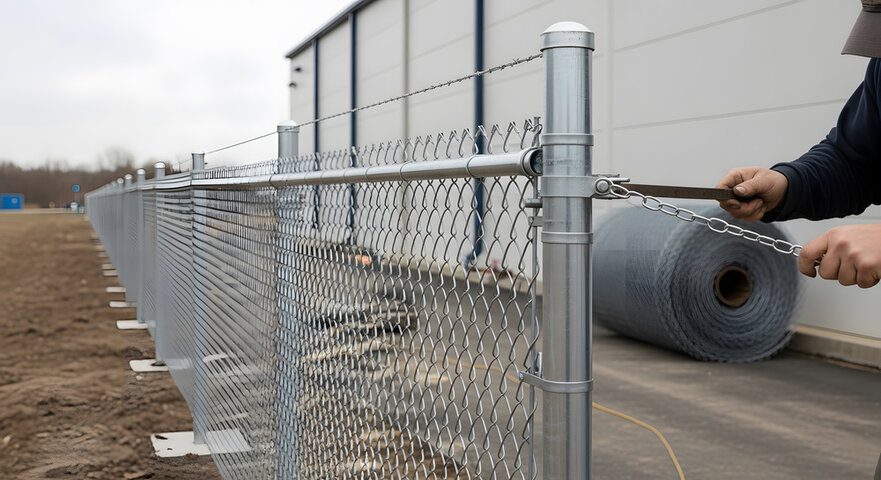
Line posts are the intermediate posts spaced along the fence run — typically every 10 feet. They support the top rail, anchor the tension wire, and are connected to the chain link fabric via tie wire. Post diameter and wall thickness determine how much load the framework can handle.
Standard residential line posts are 1-3/8″ outside diameter. Commercial line posts are 1-5/8″ or 2″ O.D. For taller fences (8 feet and above) or higher-security commercial applications, 2″ or 2-1/2″ line posts are appropriate. Using undersized line posts is a common cost-cutting measure that results in posts bowing outward under fabric tension and wind loads over time.
Terminal Posts (Corner, End, and Gate Posts)
Terminal posts take the full tensioned load of the fabric and are specified larger than line posts. Standard residential terminal posts are 1-5/8″ O.D.; commercial terminal posts are typically 2″ to 2-1/2″ depending on fence height. Gate posts supporting heavy gates — particularly automated swing gates — require substantial posts (3″ to 4″ O.D.) to handle the gate weight and dynamic loads from opening and closing cycles.
Top Rail
Top rail runs horizontally through post caps along the top of the fence, providing rigidity and support for the chain link fabric. Standard top rail is 1-3/8″ O.D. and is connected with sleeve couplings where sections join. The top rail prevents the fabric from leaning or bowing outward and gives the fence its clean, finished appearance at the top.
Tension Wire
Tension wire (also called bottom tension wire or stretcher bar wire) runs along the bottom of the fence, threaded through the bottom of the chain link fabric. It holds the bottom of the fence down — critically important in Houston where strong winds and occasional flooding can undermine fence stability if the bottom of the fabric isn’t properly secured. Tension wire gauge should match or exceed the fabric gauge.
Tension Bands and Bars
Tension bars are flat steel bars threaded through the end weave of the chain link fabric at terminal posts. Tension bands are the clips that attach the tension bar to the terminal post, anchoring the fabric under tension. The number of tension bands per terminal post scales with fence height — a 6-foot fence typically uses five bands per terminal post; an 8-foot fence uses seven.
- 1-5/8″ line posts for residential; 2″ line posts for commercial Houston installations
- Terminal posts must be larger than line posts — they carry full fabric tension load
- Top rail provides horizontal rigidity and prevents outward bow
- Tension wire at fence bottom is critical for Houston — prevents wind and flood damage from lifting fabric
- Gate posts must be oversized — particularly for automated gates (3″–4″ O.D. minimum)
Chain Link Fence Heights for Houston Properties
Chain link fence is available in a wide range of heights to match different applications. Understanding which height is appropriate — and what Houston regulations allow — helps you specify the right fence for your project.
Residential Heights (3 to 6 Feet)
3-foot chain link is used for garden borders, decorative yard separation, and low barriers where containment of small animals is the goal. Not effective for dog containment (most medium and large dogs can jump a 3-foot fence) or security.
4-foot chain link is the minimum practical height for dog containment of medium-sized dogs. Also used for front yard property boundaries where a taller fence would block sightlines. Most Houston HOAs allow 4-foot chain link in front yard setback areas.
5-foot chain link provides better dog containment and property boundary definition. Used in residential applications where a 6-foot privacy fence isn’t required or desired.
6-foot chain link is the standard residential and commercial security height. Tall enough to deter casual trespass, appropriate for dog runs and parks, pet enclosures, pool barriers (with proper top configuration), and backyard perimeters. Most Houston residential fence permits allow 6-foot maximum height for backyard fences; front yard restrictions typically limit to 3–4 feet. Check with the City of Houston and your HOA for specific requirements.
Commercial Heights (6 to 12 Feet)
6-foot commercial chain link is the minimum for most commercial applications requiring a meaningful security fence. Acceptable for office parking lots, retail rear perimeters, and other lower-security commercial uses.
8-foot commercial chain link is the standard for warehouse yards, equipment storage, construction site perimeters, and most industrial applications in the Houston area. The additional two feet of height over a 6-foot fence meaningfully increases the difficulty of scaling the fence.
10-foot chain link is used for high-security commercial perimeters, sports facility backstops, baseball/softball outfields, and batting cages. With the addition of barbed wire extension arms, a 10-foot fence with 3-strand barbed wire reaches an effective security height of 11.5 to 12 feet.
12-foot chain link is typically limited to sports facility applications (high outfield fences, tennis court backstops) and the highest-security perimeter applications. Requires substantial framework and deep, well-anchored posts.
Residential Applications of Chain Link Fence in Houston
While chain link fence is often associated with commercial and industrial use, it remains a practical and popular choice for many Houston-area residential applications.
Backyard Containment
For homeowners with dogs, chain link fence is often the most economical way to create a large, secure backyard containment area. A 6-foot black vinyl-coated chain link fence around a typical Houston suburban backyard (roughly 100×100 feet, or 400 linear feet of fence) typically costs $4,000–$6,000 installed — significantly less than a comparable wood privacy fence or iron fence. For families with multiple dogs or large breeds that need space, chain link allows a large enclosure at a price point that wood or iron simply can’t match.
Specialized chain link configurations for dogs include dog cages and kennels — fully enclosed panels with tops — that provide secure containment even for fence-climbing dogs. If you have a dog that climbs standard fences, a covered kennel or coyote-roller addition to the top of the fence can solve the problem permanently.
Pool Enclosures
Texas law requires a barrier around residential swimming pools meeting specific specifications to prevent child drowning. Chain link fence meets pool barrier code requirements when properly configured: minimum 48 inches (4 feet) tall, no openings larger than 1.75 inches that a 4-inch sphere can pass through (which standard 2-inch mesh chain link satisfies), self-closing and self-latching gate, and latch on the pool side of the gate. Chain link pool enclosures are code-compliant and cost-effective, though many Houston homeowners upgrading pool areas opt for aluminum or glass panel fencing for aesthetic reasons.
Pet Enclosures and Garden Protection
Beyond dogs, chain link fence is used to create dedicated enclosures for chickens and poultry (with hardware cloth additions for bottom protection), to protect vegetable gardens from deer and rabbits, and to delineate different areas of large properties. Mini-mesh chain link (1-inch openings) is specified for chicken coops and small animal containment where standard 2-inch openings would allow escape.
- Black vinyl chain link is the residential standard in Houston — better aesthetics than galvanized for suburban applications
- 6-foot chain link backyard enclosure (400 LF typical Houston suburban lot): $4,000–$6,000 installed
- Chain link pool enclosures are code-compliant — minimum 4-foot height with self-latching gate required
- Dog runs and kennels with covered tops solve the fence-climbing dog problem
- Mini-mesh (1-inch openings) required for poultry and small animal containment
Commercial Applications of Chain Link Fence in Houston
Chain link fence is the dominant perimeter security solution for commercial and industrial properties across the Greater Houston area. Here’s where we install commercial chain link fence installation most frequently.
Parking Lots and Vehicle Yards
Securing parking areas, controlling access, and defining property boundaries around commercial parking lots is one of the most common chain link fence applications in Houston. Chain link at 6 to 8 feet with automated entry gates provides both security and access management. Many Houston business parks, apartment complexes, and commercial properties use chain link perimeter fencing with keypad or card-reader gates for after-hours vehicle access control.
Warehouses and Distribution Centers
Houston is a major logistics hub, and warehouse security is a persistent challenge — particularly cargo theft around the Port of Houston corridor. Heavy-gauge chain link fence (9-gauge, 8-foot height) with barbed wire topping provides the perimeter security that warehouse and distribution operations require. Integration with access control systems — keypad gates, card readers, and automated gate systems — creates complete perimeter management solutions.
Schools and Sports Fields
School campuses throughout the Houston area use chain link fence to define campus perimeters, secure playgrounds, and create sports field boundaries. Sports field backstops, dugout fencing, and tennis court enclosures are standard chain link applications. Green vinyl-coated chain link is the typical specification for school sports facilities — the color blends with the field environment better than silver galvanized wire.
Sports Facilities and Recreation
Baseball and softball diamonds use chain link backstops (often 20 feet or taller) and outfield fencing. Soccer fields, lacrosse fields, and multi-purpose athletic fields use chain link perimeter fencing to keep balls in play and spectators separated from active play areas. Tennis courts are enclosed with 10-foot chain link on all sides with a gate system.
Construction Sites
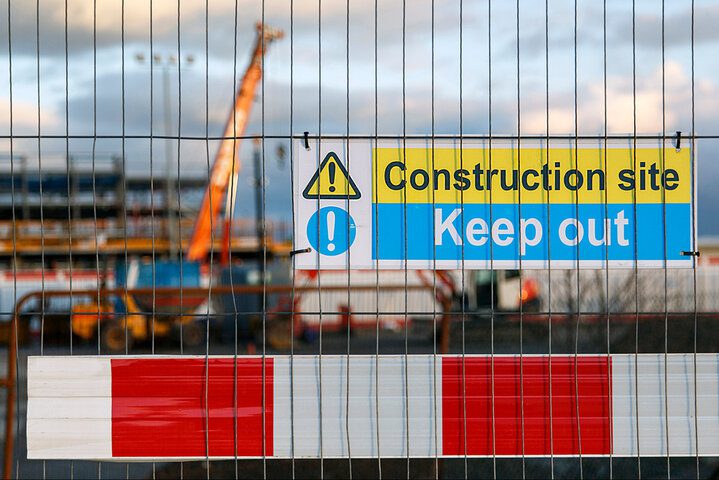
Temporary chain link fence panels (chainlink rent-a-fence) are standard for Houston construction site security, but many larger long-term projects install permanent or semi-permanent chain link fence with barbed wire topping to protect equipment, materials, and the site perimeter through the construction duration.
- Parking lot perimeter security is one of the most common Houston commercial chain link applications
- 9-gauge, 8-foot chain link with barbed wire is the standard for Houston warehouse and distribution security
- Green vinyl-coated chain link is standard for school sports facilities and parks
- Sports backstops (baseball, softball) often reach 20 feet or higher — substantial framework required
- Construction sites commonly use barbed wire chain link to prevent equipment theft overnight and on weekends
Chain Link Fence Cost Breakdown for Houston, TX in 2026
Understanding what chain link fence actually costs in Houston — not regional averages from national sites that don’t reflect local labor and material markets — is critical for budgeting and evaluating contractor bids.
Residential Chain Link Fence Pricing
Residential chain link fence in Houston, TX typically costs $8–$15 per linear foot installed for a standard 4- to 6-foot fence. The wide range reflects differences in:
- Height: 4-foot fence costs less than 6-foot fence — less fabric, shorter posts
- Wire type: Galvanized fence costs less than vinyl-coated; vinyl adds $1–$3 per linear foot
- Gauge: 11-gauge residential costs less than 9-gauge commercial-grade
- Site conditions: Flat sites cost less than sloped terrain; accessible sites cost less than tight/restricted access
- Gates: Walk gates ($150–$400) and drive gates ($500–$1,500+) add to total project cost
A typical Houston residential backyard project — 300 to 400 linear feet of 6-foot black vinyl chain link with a walk gate and drive gate — runs $3,500–$7,000 installed. Be skeptical of quotes significantly below $8 per linear foot for residential work — they typically involve lighter gauge wire, minimal concrete in post footings, or shortcuts in the framework that will shorten the fence’s life.
Commercial Chain Link Fence Pricing
Commercial chain link fence in Houston, TX runs $12–$25 per linear foot installed for standard commercial perimeter specifications. The commercial price range reflects the heavier-duty materials required:
- 9-gauge commercial fabric vs. 11-gauge residential fabric
- Larger diameter line posts (1-5/8″ to 2″ vs. 1-3/8″ residential)
- Deeper post footings (3 feet vs. 2 feet for residential)
- More concrete per footing
- Longer spans, larger gates, and more complex access control integration
A standard commercial warehouse perimeter of 1,000 linear feet with 8-foot 9-gauge chain link, drive gate, and single pedestrian gate typically costs $15,000–$25,000 installed depending on site conditions and gate specifications.
Installation Timeline
Most residential chain link fence projects in Houston are completed in 1–2 days once posts have set. The typical timeline:
- Day 1: Post layout, dig post holes, set posts in concrete
- Wait 24–48 hours for concrete to cure (Griffin Fence schedules concrete cure time into our project timeline)
- Day 2: Install top rail and framework, stretch fabric, attach hardware, hang gates
Larger commercial projects extend the timeline proportionally — a 1,000 linear foot warehouse perimeter typically takes 3–5 days depending on crew size and site conditions.
Houston Climate’s Impact on Chain Link Fence
Houston’s climate is one of the most demanding in North America for metal fencing systems. Understanding these environmental factors helps you make better material choices and manage expectations for long-term fence performance.
Humidity and Coastal Air
Houston’s average annual relative humidity of over 75%, combined with proximity to the Gulf of Mexico, creates an environment where ungalvanized or lightly-galvanized steel rusts rapidly. Even well-galvanized chain link fence will develop surface oxidation at the cut ends of the wire and at any point where the zinc coating is damaged. The closer to the coast, the more aggressive the corrosion environment — coastal Houston communities (Galveston, Clear Lake, Seabrook, Kemah, Baytown near tidal areas) should always specify vinyl-coated chain link over galvanized.
For inland Houston locations (far from the coast), Class 3 galvanized chain link with proper maintenance (prompt treatment of any surface rust) provides excellent service life. The additional cost of vinyl coating may not be necessary for purely inland, non-residential commercial applications.
Heavy Rainfall and Flooding
Houston receives an average of 49 inches of rainfall annually, and the region is subject to extreme rain events — including hurricane-related flooding. Chain link fence performs far better in flood conditions than wood fence (which can be pushed off its footings by water pressure on solid panels), but post footings must be properly sized and deep enough to remain stable after soil saturation. After major flooding, we always recommend inspecting fence posts for movement or undermining at the base.
Heat and UV Exposure
Houston’s intense summer heat and UV radiation affects vinyl coating on chain link fence over time. High-quality vinyl coatings include UV stabilizers that prevent cracking and fading for 10–15 years. Economy vinyl coatings without UV stabilizers can crack and peel within 5 years in Houston’s sun, exposing the galvanized wire beneath to direct moisture. When specifying vinyl-coated chain link for Houston, ask your contractor whether the vinyl coating meets ASTM F668 Class 2B (thick-film extrusion coating) requirements — this specification ensures UV-resistant vinyl that performs in Houston’s climate.
- Houston’s average humidity exceeds 75% year-round — accelerates galvanized coating degradation
- Coastal Houston properties (within 50 miles of Gulf): always specify vinyl-coated over galvanized
- Houston’s 49 inches of annual rainfall requires properly deep post footings for long-term stability
- UV-resistant vinyl coating (ASTM F668 Class 2B) recommended for all vinyl chain link in Houston’s climate
- Post-flood inspection important after major rain events — check for undermining and post movement
Chain Link Fence Maintenance in Houston — Protecting Your Investment
Chain link is often marketed as a “maintenance-free” fence — but that’s an oversimplification. In Houston’s environment, proactive maintenance significantly extends service life and prevents costly repairs or premature replacement.
Annual Inspection Checklist
We recommend a thorough annual inspection covering:
- Post bases: Check for rust development at the soil-steel interface — this is the most common failure point. Surface rust here can be treated with rust-inhibiting primer; severe rust may require post reinforcement or replacement
- Fabric tension: Look for loose or missing tie wires, sagging fabric sections, or areas where the fabric has pulled away from the framework
- Vinyl coating integrity (for vinyl-coated fence): Check for cracking, peeling, or areas where the vinyl has been damaged by impact or contact. Address damaged areas promptly before moisture reaches the steel core
- Gate hardware: Test hinges, latches, springs, and closers for smooth operation. Lubricate hinge pins and latch mechanisms annually
- Concrete footings: Check whether any posts have shifted — particularly after wet seasons when Houston’s clay soil heaves and shrinks with moisture changes
Rust Treatment
Surface rust on galvanized chain link fence can be treated with a wire brush to remove loose rust, followed by application of a zinc-rich rust-inhibiting primer. This stops the rust progression and restores the protective zinc layer on a localized basis. For extensive rust coverage on older fence, evaluate whether repair or replacement is more cost-effective.
Privacy and Security Upgrades
One of the benefits of chain link fence is that it can be upgraded over time without replacing the fence itself. Privacy slats can be woven or inserted into existing chain link fabric to add visual screening. Security upgrades — adding barbed wire topping, barbed wire fencing extensions, or security cameras — can be added to an existing chain link fence perimeter. The modular nature of chain link framework makes it one of the most adaptable fencing systems available.
Frequently Asked Questions — Chain Link Fence in Houston, TX
What is the best type of chain link fence for Houston’s climate?
For most residential applications in Houston, vinyl-coated chain link in black is the best choice — it provides superior corrosion resistance compared to galvanized, looks better in residential settings, and holds up well in Houston’s humidity and coastal air. For commercial and industrial applications away from the coast, Class 3 galvanized 9-gauge chain link is the commercial standard and provides excellent longevity with proper maintenance. Properties near the Gulf Coast (League City, Friendswood, Galveston, Clear Lake area) should always choose vinyl-coated over galvanized due to salt air.
How much does chain link fence cost in Houston, TX?
Residential chain link fence installation in Houston typically costs $8–$15 per linear foot. A standard residential project (300–400 linear feet of 6-foot black vinyl chain link with gates) runs $3,500–$7,000. Commercial chain link fence runs $12–$25 per linear foot depending on gauge, height, and framework specifications. For the most accurate pricing, use our fence estimator or call for a free on-site estimate. Every site is different, and online calculators can’t account for your specific site conditions.
How long does chain link fence last in Houston?
A properly installed, commercial-grade Class 3 galvanized chain link fence in Houston can last 20–30 years with minimal maintenance. Vinyl-coated chain link, when specified with UV-resistant coating, can match or exceed that lifespan. Economy chain link (Class 1 galvanized, 11.5-gauge) in Houston’s humid environment may show significant rust and degradation within 10–15 years. The three biggest factors in chain link fence longevity in Houston are coating class (Class 3 vs. Class 1), wire gauge (heavier gauge lasts longer), and proper post depth and concrete footings (prevents post heaving in Houston’s expansive clay soil).
Do I need a permit for chain link fence in Houston, TX?
Most residential fence installations in Houston, TX require a fence permit from the City of Houston or the applicable municipality. Permit requirements vary — single-family residential fences under 8 feet typically fall under a simplified permit process, while commercial fencing projects require more detailed permit applications. Griffin Fence handles the permit process for all installations as part of our service. We also verify whether your property has deed restrictions or HOA rules that may impose additional requirements beyond city code. Never install a fence without verifying permit requirements — unpermitted fences can require removal at your expense.
Schedule Your Free Chain Link Fence Estimate in Houston
Whether you need a simple residential backyard enclosure or a large commercial perimeter security fence with access control, Griffin Fence has the experience and resources to handle your project. We install all types of chain link fence Houston properties require — galvanized, vinyl-coated, mini-mesh, standard residential and heavy commercial — across the entire Greater Houston area.
Our team will visit your property, assess your needs, discuss your options, and provide a detailed written estimate with no hidden costs. We pull all required permits, handle Texas811 utility locating, and provide a written warranty on our work.
Call Griffin Fence today at (713) 937-6611 or contact us online for a free estimate. Serving Houston, TX and all of Harris County, Fort Bend County, Brazoria County, Montgomery County, and Galveston County.