The Definitive Guide to Chain Link Fence Installation Near Me in Houston, TX
When Houston homeowners and business owners search for chain link fence installation near me, they want a straightforward answer: who can install a reliable, affordable fence that holds up in Houston’s demanding environment? We’ve been answering that question for over 25 years at Griffin Fence. Chain link is the most versatile fencing material available — it secures dog runs, protects school yards, encloses commercial warehouses, and defines residential property lines with an unbeatable cost-to-durability ratio. This guide covers everything you need to know before calling a contractor, from gauge and height selection to Houston-specific installation considerations and real cost figures.
- Chain link is the most cost-effective fencing option in Houston, ranging from $8–$25 per linear foot installed depending on gauge, height, and coating
- Houston’s clay soil and coastal humidity require specific installation techniques that experienced local contractors understand
- 9-gauge wire is the residential standard; 6-gauge is required for commercial, industrial, and high-security applications
- Galvanized steel resists rust well, but vinyl-coated chain link adds an extra layer of corrosion protection ideal for Houston’s salt-air coastal proximity
- Griffin Fence installs chain link for residential, commercial, and industrial customers across the greater Houston area
What Is Chain Link Fencing? Understanding the Basics
Chain link fence — sometimes called cyclone fence or hurricane fence — is a woven wire fabric stretched between steel posts and held taut with tension bars and tension bands. The wire is interlocked in a diagonal diamond pattern that gives chain link its distinctive look and its remarkable tensile strength. Unlike wood fencing, which can rot, warp, and splinter, or vinyl fencing that can crack in extreme temperature swings, chain link maintains its structural integrity for decades with minimal maintenance.
The core components of any chain link installation include terminal posts (end, corner, and gate posts), line posts (spaced every 10 feet along straight runs), top rail running the length of the fence, the chain link fabric itself, tension bars that secure the fabric to terminal posts, brace bands, tension bands, and post caps. For taller commercial installations, a middle rail is added for additional fabric support. The quality and gauge of each component determines how long the fence will perform and how well it resists the forces Houston weather throws at it.
- Chain link consists of woven wire fabric stretched between terminal posts and line posts
- Standard residential installations use line posts spaced every 10 feet with 1-5/8″ top rail
- Commercial and industrial installs use heavier posts, larger rail, and deeper concrete footings
- All components — fabric, posts, rail, and fittings — come in galvanized or vinyl-coated versions
- Properly installed chain link requires virtually no maintenance beyond occasional washing
Chain Link Gauge: Choosing the Right Wire Thickness for Your Application
Wire gauge is the single most important specification in chain link fencing. Counterintuitively, lower gauge numbers mean thicker wire. This distinction matters enormously for durability and security. Using the wrong gauge for your application is one of the most common mistakes homeowners make when comparing quotes from different contractors — a fence quoted at 11-gauge will look identical to a 9-gauge fence when installed, but it will dent, sag, and fail years sooner.
11-Gauge Chain Link — Economy Residential
At approximately 0.120 inches in diameter, 11-gauge wire is the lightest specification commonly installed. It’s suitable for light-duty residential applications like garden enclosures and decorative property boundaries where aesthetics matter more than security. We generally don’t recommend 11-gauge for Houston backyards with dogs, children, or any security requirement. It will sag between posts over time, especially under the weight of privacy slats or wind loads. If a contractor quotes you 11-gauge for a standard residential job, push back and ask about 9-gauge pricing.
9-Gauge Chain Link — The Residential and Light Commercial Standard
Nine-gauge wire at 0.148 inches diameter is our standard recommendation for most Houston residential installations. It provides the right balance of strength, cost, and longevity. A properly installed 9-gauge galvanized chain link fence in Houston will last 15–25 years with no maintenance beyond cleaning. For dog runs, backyard enclosures, school grounds, and light commercial applications, 9-gauge is the appropriate specification. The wire is stiff enough to resist deformation from dogs jumping or leaning against it, yet flexible enough to absorb wind load without popping loose from fittings.
6-Gauge Chain Link — Heavy Commercial and Industrial
At 0.192 inches diameter, 6-gauge wire is nearly twice as thick as 11-gauge and noticeably heavier than 9-gauge. This is the specification demanded by municipalities, correctional facilities, schools with security requirements, commercial warehouses, and construction sites. Six-gauge chain link resists cutting tools that would easily defeat lighter fabric. The heavier wire requires larger, heavier posts set deeper in concrete, which is why commercial installations cost significantly more than residential work. When clients ask us about high-security perimeters or when local codes require it, 6-gauge is the answer. Houston ISD facilities, for example, commonly specify 6-gauge for their perimeter fencing.
4-Gauge and 3-Gauge — Maximum Security
These extremely heavy gauges are used for correctional facilities, military installations, and maximum-security industrial sites. Installation requires specialized equipment and expertise. While Griffin Fence is capable of installing these specifications, most Houston commercial projects are well-served by 6-gauge unless a security consultant has specifically mandated heavier material.
- 11-gauge: Economy residential only — not recommended for pets, children, or security
- 9-gauge: Standard residential and light commercial — the right choice for most Houston properties
- 6-gauge: Commercial, industrial, schools, and high-security applications — significantly stronger and longer-lasting
- Always confirm the gauge specification in writing before signing a contract — it’s not visible once installed
- Griffin Fence stocks 9-gauge and 6-gauge fabric and will specify gauge in all written estimates
Galvanized vs Vinyl-Coated Chain Link: What’s Best for Houston?
Once you’ve determined the right gauge, the next decision is coating. Chain link fabric and posts come in two primary finishes: galvanized (zinc-coated steel) and vinyl-coated (PVC-coated over galvanized steel). Both protect against corrosion, but they do so differently, and Houston’s environment makes this choice particularly important.
Hot-Dip Galvanized Chain Link
Galvanized chain link is submerged in molten zinc, which bonds metallurgically to the steel and creates a barrier against oxidation. The resulting silver-grey finish is familiar to most people as the standard chain link look. Hot-dip galvanized is the most cost-effective corrosion protection and performs excellently in most Houston environments. Properly galvanized steel resists rust for decades even in high humidity. The coating is self-healing in small areas — if the wire is nicked or scratched, the zinc around the damaged area provides sacrificial protection to the exposed steel. For inland Houston properties where corrosion exposure is primarily from rainfall and humidity, galvanized chain link is an excellent choice.
Vinyl-Coated Chain Link
Vinyl-coated chain link adds a layer of PVC over galvanized wire, providing both color options and an additional barrier against corrosion. The most popular color is black vinyl chain link, which offers a dramatically more attractive appearance than silver galvanized wire while maintaining all the structural benefits of chain link. Green vinyl is common for parks and schools. The vinyl coating is particularly valuable for Houston properties near the Gulf Coast, Galveston Bay, or the Houston Ship Channel, where salt air accelerates corrosion. Vinyl-coated chain link also holds up better to Houston’s intense UV exposure — the PVC coating prevents the sun from bleaching and weakening the underlying metal as quickly.
The trade-off with vinyl-coated chain link is cost (roughly 20–30% more than galvanized) and repairability. Once the vinyl coating is punctured or torn, the steel beneath is exposed and can rust. We recommend vinyl-coated chain link for any property within 30 miles of the coast, for residential applications where appearance is a priority, and for any installation where the fence will be regularly in contact with sprinkler systems or standing water. For utilitarian commercial applications in inland Houston, galvanized steel is entirely appropriate and will deliver decades of reliable service.
- Galvanized chain link is the cost-effective standard, providing excellent corrosion resistance for most Houston applications
- Vinyl-coated chain link (especially black) is preferred for residential aesthetics, coastal properties, and areas with high UV or salt exposure
- Vinyl coating adds roughly 20–30% to material cost but significantly improves appearance and corrosion resistance
- For properties near Galveston Bay, the Ship Channel, or coastal areas, vinyl coating is strongly recommended
- Both coatings are available in 9-gauge and 6-gauge fabric — specify both gauge and coating when getting quotes
Chain Link Fence Heights: Matching Height to Application
Chain link fabric is manufactured in standard heights ranging from 3 feet to 12 feet, with the most common sizes being 3.5, 4, 5, 6, 8, 10, and 12 feet. Selecting the correct height is both a functional and regulatory decision. Houston and Harris County have specific requirements for residential and commercial fence heights, and these vary by zoning district and application.
3 to 4-Foot Heights — Residential and Decorative
Three-and-a-half to four-foot chain link is common for front yard boundaries, garden enclosures, and properties where the fence is meant to define rather than secure. At this height, chain link allows maximum visibility and does not require permits in most Houston residential zones. Four-foot chain link is also popular for dog runs and parks, particularly for smaller breeds. Be aware that athletic or determined large dogs can clear a four-foot fence — if you have a Labrador, German Shepherd, or similar athletic breed, consider 5- or 6-foot height.
5 to 6-Foot Heights — Standard Residential Security
Five-foot and six-foot chain link covers the vast majority of residential backyard, side yard, and property perimeter applications in Houston. Six feet is the maximum height permitted without a variance in most Houston residential zones, and it provides effective containment for virtually all dog breeds and a reasonable deterrent against casual trespass. At six feet, chain link provides real security while remaining within residential code limits. This is our most commonly installed height for Houston residential customers.
8-Foot Heights — Commercial Standard
Eight-foot chain link is the standard for commercial properties, school perimeters, construction sites, and anywhere meaningful security is required. At this height, climbing the fence is a serious physical challenge rather than a quick hop. Most Houston commercial zones permit eight-foot fencing without special variance. For commercial applications, we install 8-foot fabric on schedule 40 steel posts set 36 to 42 inches deep in concrete — deeper than residential installations to account for Houston’s expansive clay soil.
10 to 12-Foot Heights — Maximum Security and Industrial
Ten-foot and twelve-foot chain link is installed at prisons, power plants, chemical facilities, and maximum-security industrial sites. At these heights, the fence typically incorporates extended arms at the top angled outward at 45 degrees to support three strands of barbed wire. The increased height requires proportionally heavier posts, deeper footings, and bracing at corners and gates. Our team is experienced with these specifications for Houston’s extensive industrial corridor along the Ship Channel and I-10 East.
- 4-foot: Front yards, gardens, small dog runs — decorative with basic containment
- 6-foot: Standard residential backyard height in Houston — contains dogs, provides security
- 8-foot: Commercial standard — meaningful security for businesses, schools, and construction sites
- 10–12 foot: Industrial and maximum security — requires heavier posts and deeper footings
- Always verify Houston zoning height limits before selecting fence height — we handle permit research for our customers
Chain Link Fence Security Add-Ons: Barbed Wire, Privacy Slats, and More
Standard chain link provides perimeter definition and basic security, but several add-ons dramatically increase both security and functionality. Understanding these options helps you build exactly the fence your property needs.
Barbed Wire and Razor Wire
Three-strand barbed wire installed on extended arms above an 8-foot or taller chain link fence is the most common commercial security upgrade in Houston. The arms — typically 15 inches long, angled outward at 45 degrees — support the barbed wire strands and make it extremely difficult to climb over the fence. Barbed wire adds roughly $2–$4 per linear foot to installation cost. Razor wire (concertina wire) provides a higher deterrent and is used on industrial and commercial properties where security requirements are highest. Houston municipal code restricts residential use of barbed wire, so this is primarily a commercial and industrial upgrade. Our team handles all permitting for barbed wire installations to ensure compliance with City of Houston and Harris County regulations.
Privacy Slats
One of the most popular upgrades to chain link is the addition of privacy slats woven vertically through the chain link fabric. Available in aluminum or high-density polyethylene (HDPE), privacy slats convert a transparent chain link fence into an opaque privacy screen. They come in a range of colors and provide 85–95% privacy coverage depending on slat width and weave style. Aluminum slats are more durable but cost more; HDPE slats are cost-effective and come in a wider color range. Privacy slats add $3–$7 per linear foot depending on material and coverage percentage. For Houston backyards where homeowners want the durability of chain link without sacrificing privacy, slats are an excellent solution.
Bottom Tension Wire and Bottom Rail
For dog containment, a bottom tension wire or bottom rail is essential. Without this, determined dogs can push under the fabric and escape. A bottom tension wire runs along the ground level of the fence and keeps the fabric taut against the soil. A bottom rail is more expensive but provides a rigid lower edge that is more difficult for dogs to lift. For dog runs, we also recommend turning the bottom of the fabric outward along the ground (an “apron”) to prevent digging out — this adds 6–12 inches of fabric along the ground inside or outside the fence line and is particularly important for Houston’s sandy loam and fill soils where digging is easy.
Gates and Hardware
A chain link fence is only as functional as its gates. Residential installations typically include one or two single walk gates (3–4 feet wide) and optionally a double drive gate (10–14 feet wide for vehicle access). Commercial installations may include multiple walk gates, large double drive gates, and sliding gates for high-traffic vehicle access. Gate frame size, hinge hardware, and locking mechanisms all need to be matched to the gate dimensions and usage frequency. For commercial sites with daily vehicle traffic, heavy-duty cantilever sliding gates are significantly more reliable than swinging drive gates.
- Barbed wire adds $2–$4/ft and requires City of Houston permits — we handle all permitting
- Privacy slats convert chain link to an 85–95% privacy screen for $3–$7/ft additional
- Bottom tension wire or bottom rail is essential for dog containment — prevents digging and squeezing under
- Cantilever sliding gates are recommended for commercial sites with daily vehicle traffic
- All security add-ons must be specified before installation — retrofitting is more expensive than installing from the start
Chain Link Fence Cost in Houston: Real Pricing by Specification
We believe in transparent pricing, which is why we publish realistic cost ranges. Vague answers like “it depends” don’t help Houston homeowners and business owners plan their projects. Here’s what you can realistically expect to pay for professional chain link fence in Houston.
Residential Chain Link — Installed Cost Per Linear Foot
For standard residential applications — 4-foot to 6-foot galvanized 9-gauge chain link on 1-5/8″ top rail with line posts every 10 feet — expect to pay $8–$14 per linear foot installed in Houston. This includes all materials (posts, fabric, top rail, hardware, concrete for post footings) and labor. A 150-foot backyard perimeter fence at this specification runs $1,200–$2,100 including a standard walk gate. Adding black vinyl coating instead of galvanized increases material cost by approximately 20–30%, bringing the range to $10–$18 per linear foot. Privacy slats add another $3–$7 per foot.
Commercial Chain Link — Installed Cost Per Linear Foot
Commercial chain link using 6-gauge fabric, schedule 40 2-3/8″ line posts, and 2-1/2″ terminal posts on 42-inch deep concrete footings runs $15–$25 per linear foot for 8-foot heights. Large commercial projects (500+ linear feet) typically receive volume pricing in the lower end of this range. Adding three-strand barbed wire on extended arms adds $2–$4 per foot. For 10-foot and 12-foot heights, add $3–$6 per foot to the base price. A 400-foot commercial perimeter at 8-foot 6-gauge galvanized with barbed wire runs approximately $7,000–$11,600 installed.
Additional Cost Factors in Houston
Houston’s terrain and soil conditions affect installation cost. Properties with significant slope require extra fabric and labor — stepped or racked installation (where the fabric follows the grade) is standard, but very steep slopes or terraced lots may require custom post heights that add cost. Houston’s notoriously expansive clay soil (especially in older neighborhoods like Bellaire, West U, and the Heights) requires deeper post footings — we typically set posts 36–42 inches deep versus 24–30 inches in stable sandy soils — which means more concrete and more time. Use our online fence estimator to get a rough budget figure before calling for a site visit.
- Residential 9-gauge galvanized 6-foot chain link: $8–$14/ft installed in Houston, TX
- Residential vinyl-coated (black/green): $10–$18/ft installed
- Commercial 6-gauge galvanized 8-foot: $15–$22/ft installed
- Commercial 6-gauge with barbed wire: $18–$25/ft installed
- Slopes, clay soil, and difficult access add 10–20% to base pricing
- All estimates include concrete post footings, hardware, and one standard gate
Houston-Specific Installation Considerations: Clay Soil, Humidity, and Hurricane Loads
Installing chain link in Houston is not the same as installing it in Denver or Phoenix. Houston’s environment presents challenges that only experienced local contractors know how to handle. This is one of the most important reasons to work with a dedicated local fence company rather than a handyman or out-of-town contractor who quotes low but lacks the regional knowledge to install correctly.
Houston Clay Soil
Houston sits on some of the most expansive clay soil in North America. This clay — locally known as Houston Black Clay or Beaumont Clay — absorbs water and expands dramatically in wet weather, then contracts and cracks in dry periods. This constant heaving and settling is the primary reason fences fail prematurely in Houston. Fence posts that are set too shallow or in undersized concrete footings will heave, tilt, and eventually lean within a few years. Our standard residential installation uses 2-3/8″ round steel posts set a minimum of 30 inches deep in 10-inch diameter concrete footings. For commercial applications and fence heights over 6 feet, we go deeper — 36 to 42 inches — to ensure the post base is below the active clay zone. We also use ready-mix concrete rather than dry-pack, which creates a more consistent footing in Houston’s variable soil conditions.
Humidity, Salt Air, and Corrosion
Houston’s relative humidity averages 74% year-round, and properties within 40–50 miles of the Gulf Coast are also exposed to salt-laden air from tropical weather systems. This combination accelerates corrosion on any metal surface. For galvanized chain link, we recommend using Class 3 (heavy-coat) galvanized fabric and hardware, which provides substantially more zinc per square foot than Class 1 material. For coastal Houston properties (Seabrook, La Porte, Baytown, League City, Galveston Bay areas), we strongly recommend vinyl-coated chain link and hot-dip galvanized posts rather than electro-galvanized posts. The extra upfront cost is repaid in a fence that lasts 20 years instead of 10.
Hurricane and High-Wind Loads
Houston sits in a high-wind zone — the Building Code requires fences to resist 120 mph wind gusts in some classifications. Chain link actually handles high winds better than solid wood or vinyl privacy fences because the open fabric allows wind to pass through rather than creating a full sail effect. However, gates and terminal posts still bear significant loads in a direct storm hit. We install all terminal posts with additional concrete footing and use larger diameter steel for gates and corners. When privacy slats are installed, the fence becomes much more solid and wind load increases significantly — this is a factor we account for in our post-sizing and footing depth calculations.
- Houston clay soil requires deeper post footings (30–42 inches) than national standard depth recommendations
- We use ready-mix concrete rather than dry-pack to ensure consistent footing quality in expansive clay
- Coastal Houston properties should use vinyl-coated fabric and hot-dip galvanized posts for maximum corrosion resistance
- Chain link handles hurricane winds better than solid fencing because wind passes through the open fabric
- Privacy slats increase wind load — larger posts and deeper footings are required when slats are specified
Residential vs Commercial Chain Link Applications in Houston
Chain link serves dramatically different purposes in residential and commercial contexts, and the specification requirements differ accordingly. Understanding these differences helps you communicate your needs clearly when getting quotes.
Residential Applications
The most common residential chain link applications in Houston include backyard perimeter fencing (replacing or supplementing wood privacy fences), dedicated dog run enclosures (typically 10×20 to 20×50 feet with a gate), pool enclosures (chain link can satisfy Texas pool safety code requirements), side yard gates, and garden enclosures. Residential chain link is almost always 4-foot to 6-foot galvanized or vinyl-coated 9-gauge material. Homeowners choose chain link for residential use primarily for cost (it’s 50–70% less expensive than comparable wood privacy fencing), durability (no rot, no paint required), and suitability for pet containment. Chain link also has excellent drainage properties — unlike wood which can trap moisture and rot at the base, chain link posts are sealed at the top and the fabric itself doesn’t hold water.
Commercial and Industrial Applications
Houston’s commercial and industrial sector is one of the largest in the country — the Port of Houston, the Texas Medical Center, the Energy Corridor, and hundreds of manufacturing and distribution facilities all require serious perimeter fencing. Commercial chain link applications include construction site perimeters (temporary or permanent), warehouse and distribution center boundaries, school and university campus perimeters, park and recreation facility enclosures, parking lot delineation, equipment yard security, and oil and gas facility perimeters. Commercial specifications demand 6-gauge or heavier fabric, schedule 40 steel posts, deeper concrete footings, and typically incorporate security add-ons like barbed wire, security mesh, or camera mounts. Learn more about our installation process to understand how we approach commercial projects from initial site assessment through final inspection.
- Residential chain link: 4–6 ft, 9-gauge galvanized or vinyl-coated, primarily for pets, property definition, and pool enclosures
- Commercial chain link: 8–12 ft, 6-gauge galvanized, with security add-ons for warehouses, schools, and construction sites
- Chain link is 50–70% less expensive than wood fencing for equivalent perimeter lengths
- Commercial installations require deeper footings, heavier posts, and permit coordination — not a DIY project
- Griffin Fence serves both residential and commercial customers across greater Houston with the same level of craftsmanship
Chain Link Fence Installation Process: What to Expect
Understanding the installation process helps you prepare your property and set realistic expectations for your project timeline. Our installation process follows a consistent workflow developed over 25 years of Houston fence installations.
Site Survey and Layout
Before any digging begins, we walk the property with you to confirm the fence line, identify underground utilities (we call 811 for utility locates on every job), note any grade changes that require stepped or racked installation, and agree on gate locations. In Houston, utility lines — gas, water, conduit — can be surprisingly shallow, especially in older neighborhoods. Our team takes utility location seriously because a struck gas line is a life safety issue, not just a project setback.
Post Setting
Terminal posts (corners, ends, and gate posts) are set first because they define the fence line. We auger post holes to the appropriate depth — 30 inches minimum for residential, 36–42 inches for commercial — and use 10-inch diameter footings for residential line posts and 12-inch diameter footings for terminal posts. Each post is plumbed level on two axes before concrete is poured. In Houston’s clay soil, we allow concrete to cure a minimum of 24 hours before stretching fabric. Some crews will stretch the same day — we don’t, because posts that aren’t fully cured in clay soil can shift under the tension load and result in a wavy, misaligned fence.
Top Rail Installation and Fabric Stretching
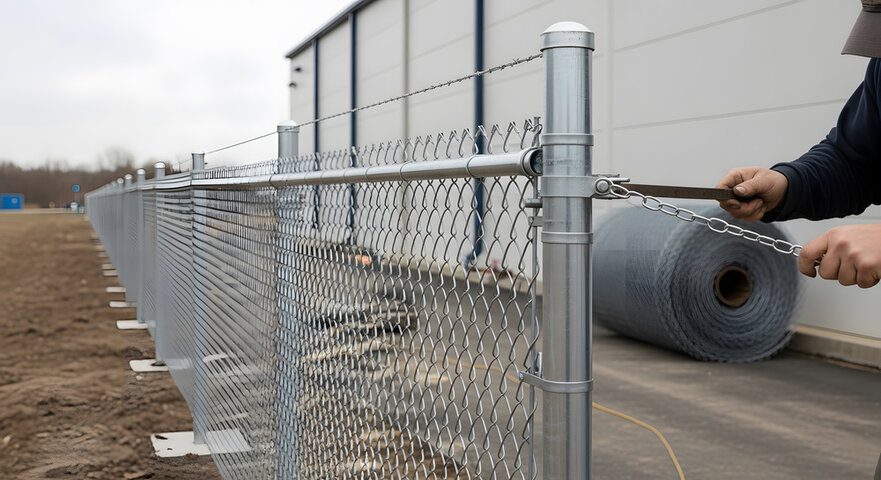
After posts cure, top rail is cut and connected using rail couplings, then threaded through the loop caps on line posts. Chain link fabric is then unrolled along the fence line and attached to the first terminal post using tension bars clipped through the terminal post’s brace band assembly. A fence stretcher tool (pull-bar or come-along) is used to pull the fabric taut from post to post — proper tension is critical. Under-tensioned fabric sags between posts and looks unprofessional; over-tensioned fabric can pull post-mounted fittings out of alignment. Experienced installers know the correct tension by feel and by the visual straightness of the fabric’s diamond pattern.
Hardware, Gates, and Finishing
After the fabric is stretched and secured, gates are hung and adjusted for level swing and proper latch engagement. Post caps are installed on all line and terminal posts to prevent water intrusion and bird nesting inside the hollow steel tubes. For commercial installations with barbed wire, barb arms are installed on terminal and line posts and wire is strung at consistent tension. For privacy slat installations, slats are typically installed by the crew after the fence is complete. Final walk-through with the homeowner or site manager ensures everything meets specifications before we consider the job complete.
- We call 811 for utility locates on every job before any digging
- Concrete must cure a minimum of 24 hours before fabric stretching — we do not rush this step
- Proper fabric tension is a skill developed through thousands of installations — it’s not visible in a spec sheet
- Final walk-through with the customer confirms the installation meets all specifications before job completion
- Permits are pulled and inspections coordinated by our office for all jobs requiring them
How to Choose a Chain Link Fence Contractor in Houston
Not all fence contractors are created equal. Houston has dozens of fence companies ranging from established commercial contractors to two-person operations working out of a pickup truck. While smaller outfits can sometimes do quality residential work, choosing the wrong contractor for a significant project — especially a commercial installation — can result in a fence that fails inspection, requires expensive remediation, or simply doesn’t meet the specification you paid for.
Verify that any contractor you’re considering carries both general liability insurance and workers’ compensation insurance. Ask for certificates before signing a contract. A contractor without workers’ comp is a significant liability for the property owner if a worker is injured on your property. Verify that the contractor has experience with the specific specification you need — a contractor who primarily installs 4-foot residential chain link may not have the right equipment (specifically, commercial post drivers and hydraulic augers) for a 300-foot 8-foot commercial installation. Ask to see recent comparable projects. Read reviews on Google and the Better Business Bureau. And be cautious of prices that seem dramatically lower than competitive quotes — the fence business has few shortcuts, and a low-ball bid usually means cut specifications, unlicensed subcontractors, or inadequate concrete.
Griffin Fence has been serving Houston since 1993. We carry all required insurance, we pull permits on every job that requires them, and we back our work with a written warranty. Use our fence estimator to get a preliminary budget figure and then contact us for a detailed site-specific quote.
- Verify general liability and workers’ compensation insurance before signing any contract
- Ask for references from similar projects (same height, gauge, and application)
- Commercial installations require specialized equipment — confirm the contractor has it
- Low-ball bids typically mean inferior gauge, insufficient concrete, or unlicensed workers
- Griffin Fence has 25+ years in Houston, full insurance coverage, and a written warranty on all installations
Frequently Asked Questions About Chain Link Fence Installation in Houston
How long does chain link fence installation take in Houston?
Most residential chain link fence installations are completed in one to two days. A typical 150–200 linear foot backyard fence with one walk gate and one drive gate can generally be completed in a single day by an experienced crew. Larger commercial projects are planned in phases — post setting on day one, fabric stretching and hardware installation on day two or three after concrete cures. We provide specific timeline estimates as part of our proposal process so you can plan accordingly. Houston weather — particularly summer heat and periodic heavy rainfall — can extend timelines, and we reschedule around significant rain events to ensure concrete cures properly.
Do I need a permit for chain link fence installation in Houston?
In the City of Houston proper, fence permits are required for fences over 6 feet in height or for any fence in a front yard. Most residential backyard chain link installations under 6 feet do not require a permit within Houston city limits. However, Houston ETJ (Extra-Territorial Jurisdiction) areas and incorporated suburbs like Sugar Land, Katy, and The Woodlands have their own permit requirements that differ from Houston city code. Commercial installations almost universally require permits regardless of height. We research applicable permit requirements for every project and handle all permit applications as part of our service.
Can chain link fence withstand Houston hurricanes?
Chain link is actually one of the better fence types for hurricane-prone areas because the open diamond pattern allows wind to pass through rather than creating the sail effect that topples solid wood and vinyl privacy fences. The primary vulnerability in a hurricane is not the fabric itself but the posts and their footings. Our commercial post installation practices — deep footings, large diameter posts, and heavy concrete — provide substantial wind resistance. For residential chain link, the fence fabric may deform in a direct hit from a major hurricane, but properly set posts typically survive intact. After Hurricane Harvey in 2017 and Beryl in 2024, we repaired significant wood fence damage throughout Houston while most chain link installations remained functional.
What is the life expectancy of chain link fence in Houston?
Properly installed chain link fence in Houston typically lasts 15–25 years for residential galvanized installations and 20–30 years for commercial 6-gauge galvanized installations. Vinyl-coated chain link generally lasts longer than bare galvanized in Houston’s coastal environment because the PVC coating provides an additional barrier against the humidity and salt air that accelerates zinc oxidation. The primary failure mode for chain link in Houston is not fabric failure but post corrosion at the base — where the steel exits the concrete and is exposed to the soil and moisture interface. Using hot-dip galvanized posts (rather than mill-galvanized) and ensuring posts are properly capped at the top significantly extends service life.
Get a Free Chain Link Fence Estimate From Griffin Fence
We’ve been installing chain link fence across Houston for over 25 years — from four-foot residential dog runs in Katy to twelve-foot industrial perimeters along the Ship Channel. We know Houston’s clay soil, we know its building codes, and we know how to install a fence that holds up through the heat, the humidity, and the occasional hurricane. Whether you need a straightforward residential backyard fence or a large commercial perimeter project, our team has the equipment, experience, and written warranty to back our work.
Call Griffin Fence today at (713) 937-6611 or contact us online for a free estimate.
External Resources: ASTM F1083 Standard Specification for Pipe, Steel, Black and Hot-Dipped, Zinc-Coated, Welded and Seamless | City of Houston Chapter 42 Development Regulations