When a business calls us about a new perimeter, the first question is almost always the same: what will a commercial fence installation cost in Houston, TX? The honest answer is that pricing depends on your site, your security goals, and how much gate/access work is involved. The good news is that once you understand the cost drivers, you can budget realistically and avoid the two biggest surprises we see: underestimating gates and underestimating site prep.
In this guide, we’ll walk through how we build a commercial fencing budget in Houston, TX, what typically moves the price up or down, and how to get an estimate that actually matches the final invoice.
Quick cost planning takeaways for Houston commercial fences
- Most budgets are driven by linear footage, fence height, material type, and gate count.
- Security upgrades (barbed wire, tighter mesh, anti-climb, access control) can change pricing fast.
- Site conditions in Houston (soft soils, drainage, underground utilities) often affect labor and footing work.
- For large perimeters, value engineering usually means simplifying the layout and right-sizing gate locations.
What affects commercial fence installation cost in Houston, TX?
Commercial fence pricing is rarely just “price per foot.” We price it like a system: perimeter fence + gates + access control + prep + compliance. Here are the biggest factors.
1) Linear footage and layout complexity
Start with total linear footage. A 600-foot run is a different project than 2,500 feet around an industrial yard. Layout matters too: lots of corners, elevation changes, and tight access areas slow crews down and add materials (terminal posts, bracing, hardware).
- Measure the perimeter on a site plan or use a measuring wheel on site.
- Mark all corners, existing gates, and areas with obstructions (dumpsters, loading docks, generators).
- If you’re early in planning, our Fence Estimator can help you sanity-check footage before you request bids.
2) Fence height (and Houston zoning / site requirements)
Height is one of the most predictable cost multipliers. More height means more fabric/pickets/panels, longer posts, and often deeper or larger footings. For commercial properties, we commonly see 6–8 ft perimeters, with taller options for higher-security needs.
- Choose height based on risk and site use (retail vs warehouse vs laydown yard).
- Confirm local requirements and any landlord/HOA rules for business parks.
3) Material choice: chain link, ornamental iron, and high-security options
In Houston, two common commercial approaches are (a) chain link for value and coverage and (b) ornamental iron for a cleaner look with strong boundary definition. We help clients match the material to the purpose:
- Chain link offers great coverage for large runs and visibility for safety and monitoring. Learn more on our Chain Link Fencing in Houston, TX page.
- Ornamental iron is often chosen for offices, storefronts, and properties that need curb appeal. See examples on Iron Fencing in Houston, TX.
- Security fencing and anti-climb designs can make sense for yards with equipment, inventory, or high liability exposure.
For chain link budgeting benchmarks, consumer-level resources cite wide ranges depending on height, gauge, and site conditions; for example, Angi notes installed chain link costs can run roughly $8–$40 per linear foot depending on specs (Angi chain link fence cost guide). For security planning ideas (like height, barbed wire arms, and clear zones), the Chain Link Fence Manufacturers Institute also shares practical design guidance (Chain Link Fence Manufacturers Institute security fencing guidelines).
4) Post type, footings, and Houston soil conditions
Houston-area soils can vary from sandy pockets to clay-heavy areas that hold water. That matters because posts need solid, stable footings. If your site has poor drainage or you’ve had posts lean in the past, it’s worth discussing deeper footings, better concrete work, and drainage fixes as part of the project rather than as a repair later.
- Expect extra attention near ditches, swales, and low areas that stay wet.
- Plan for underground utilities locates before drilling (especially near older commercial corridors).
5) Gates: the most common “budget surprise”
If you want a realistic commercial fence estimate, you have to get gates right. A perimeter fence might be straightforward, but gates add hardware, reinforced posts, operators, electrical work, safety loops, and access controls.
- Pedestrian gates (employee entrances) often need closers, panic hardware, or keyed access.
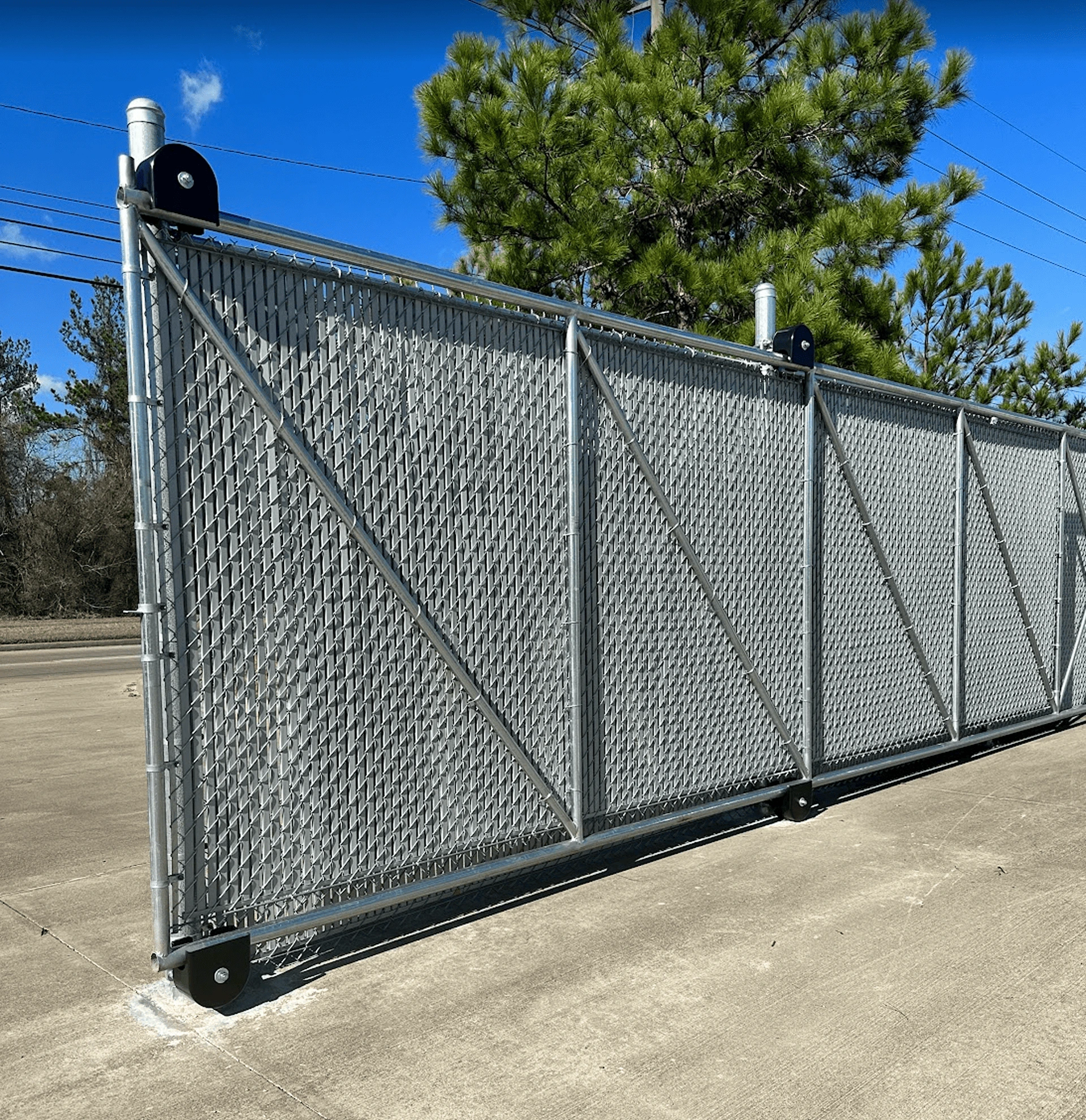
- Drive gates may be swing or slide, with different space requirements and structural demands.
- Automated gates add operator cost plus power, trenching, and safety equipment.
If your project includes controlled entry, review our Access Control Fencing in Houston, TX capabilities so the fence and the entry system are designed together.
6) Security upgrades: barbed wire, tighter mesh, and “no handholds” details
Security add-ons can be valuable, but they also change the scope. In higher-risk applications, we may discuss items like barbed wire arms, smaller mesh openings, or anti-climb features. Industry guidance notes that increasing height and removing easy handholds (like a top rail) can make climbing more difficult (CLFMI security fencing guidelines).
- Decide whether you need deterrence, delay, or full access control and monitoring.
- Make sure upgrades don’t conflict with code, visibility, or tenant safety needs.
7) Demolition, clearing, and site preparation
Removing an old fence, clearing brush, leveling a narrow strip for the new fence line, or dealing with concrete and asphalt edges all add time. In Houston, we often see overgrown fence lines behind warehouses or along easements. Budget for:
- Old fence removal and haul-off
- Vegetation clearing (especially along tree lines)
- Minor grading or compacted base work for gate areas
How we build a practical budget (step-by-step)
If you’re trying to budget before you request bids, here’s a method that works well for most facilities and property managers.
Step 1: Define the goal (security, traffic control, appearance, or all three)
Different goals produce different specifications. A laydown yard needs different fencing than a medical office. If you’re unsure where to start, browse our Commercial Fencing in Houston, TX page for common use cases we install around Houston.
- Security focus: prioritize height, climb resistance, and controlled access points.
- Operations focus: prioritize visibility, traffic flow, and gate reliability.
- Appearance focus: prioritize ornamental materials and clean lines.
Step 2: Measure linear footage and count openings
We recommend listing every opening on a simple diagram: pedestrian gates, drive gates, and any areas that need future access. Overbuilding gates is expensive; underbuilding them creates daily operational pain.
Step 3: Choose a “base” fence spec, then add options
Pick a base system (chain link or ornamental iron) and then add the options you truly need. This keeps bids comparable across contractors. If you want help standardizing scope, our Our Process explains how we scope and stage projects.
Step 4: Plan for permits, code, and safety requirements
Commercial projects may need permits depending on location, height, and site constraints. We also plan around safe gate operation, sight lines, and pedestrian routing so the fence improves safety rather than creating pinch points.
Step 5: Decide how you want to pay (and whether financing helps)
For larger projects, breaking work into phases or using financing can protect cash flow. If you’re exploring payment options, see Financing.
Common commercial fence scenarios (Houston examples)
We install commercial fencing across Houston, from retail centers near major corridors to industrial properties with heavy truck traffic. Here are a few scenarios where pricing commonly shifts:
- Shopping centers: often prioritize ornamental looks in front and more economical materials on the back perimeter.
- Warehouses: commonly need large sliding gates and reinforced access points for trucks.
- Multi-tenant business parks: may require uniform specs, controlled pedestrian access, and clear property line coordination.
FAQ: Commercial fence installation cost in Houston, TX
How do I estimate commercial fence cost “per foot”?
Start with linear footage and a base material, but add gates and site prep as separate line items. Gates and automation are often the biggest swing factor in the final number.
What’s the biggest driver of commercial fence cost?
For many properties, it’s gates (quantity and complexity). For large sites, total footage and height also dominate the budget.
Is chain link or iron cheaper for commercial properties?
Chain link is usually the value choice for long runs, while ornamental iron typically costs more but delivers a premium appearance. We often design a hybrid approach to balance budget and curb appeal.
Do automated gates always require access control?
Not always, but it’s smart to plan them together. Access control choices (keypads, card readers, cameras) affect wiring, trenching, and safety loops, so designing the system upfront saves money.
Ready for a commercial fence estimate?
When you’re ready, we can review your site plan, walk the property, and build a clear scope so your bids are apples-to-apples. We’ll also explain options to control cost without sacrificing security.
Call Griffin Fence today at (713) 937-6611 or contact us online for a free estimate.