Commercial fence installation in Houston TX involves a fundamentally different scope than residential work. Security requirements are more demanding, materials need to perform at greater scale, code compliance carries higher stakes, and installation timelines must often fit around active business operations. Whether you are securing a warehouse district property, enclosing a construction site, or defining the perimeter of a medical campus, understanding what commercial fencing actually involves helps you select the right contractor and the right solution.
What Makes Commercial Fencing Different from Residential?
The distinctions between commercial and residential fence projects go beyond project size. Commercial fencing typically involves:
- Heavier materials: Commercial chain link uses 9-gauge wire vs. 11-gauge for residential. Commercial ornamental iron uses larger steel profiles and heavier posts.
- Taller heights: Commercial security fencing commonly runs 8 to 12 feet, compared to the 4 to 6 feet standard for residential.
- Mandatory permits: Most commercial fencing projects in Houston require permits, site plan submittals, and inspections regardless of height or material.
- Access control integration: Commercial properties frequently require electronic entry management — keypads, card readers, vehicle loop detectors, automatic gates, and intercoms — integrated with the fence and gate system.
- Faster installation timelines: Businesses often need fencing completed within tight windows to minimize operational disruption or meet project milestone requirements.
- Higher liability stakes: Inadequate security fencing at a commercial property can create liability exposure if unauthorized access leads to theft, injury, or property damage.
Common Commercial Fence Types in Houston
Heavy-Duty Chain Link
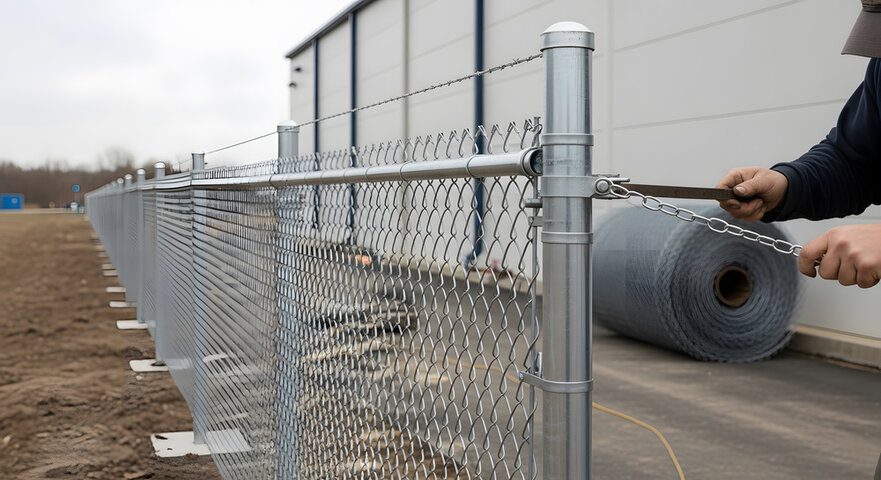
Commercial chain link is the most widely used security perimeter solution for Houston’s industrial and commercial properties. Warehouses, equipment yards, parking facilities, utility compounds, construction sites, and distribution centers all rely on it for its combination of durability, cost-effectiveness, and scalability. Commercial-grade installations use 9-gauge wire, larger post diameters, deeper footings, and heavier top rail and tension hardware compared to residential chain link.
Options include barbed wire topping for maximum deterrence, black vinyl-coated finish for client-facing or public-adjacent commercial properties, and privacy slat systems for properties that need visual screening alongside security containment.
For large-perimeter commercial projects in Houston, chain link offers the best combination of installed cost per linear foot, durability in Houston’s climate, and the ability to scale across acres of perimeter without complex fabrication lead times.
Ornamental Iron Fencing
For professional services businesses, medical facilities, schools, financial institutions, and commercial properties where brand image and aesthetics matter alongside security, ornamental iron creates a polished perimeter that reinforces professional credibility. Iron fence and gate systems integrate naturally with electronic access control to create secure, attractive entry points.
Custom ornamental iron fabrication allows commercial properties to match their fence design to the building’s architectural character — important for healthcare campuses, office parks, and high-end retail properties where the fence is part of the property’s public face.
Perimeter Wood Fencing
Some commercial properties — garden centers, nurseries, automotive service businesses, retail storage yards, and similar operations — use perimeter wood fencing to define boundaries, provide visual screening from adjacent properties or roadways, and create an enclosed operational space. Commercial wood perimeter fencing uses heavier posts, larger rail dimensions, and sometimes steel posts to handle the larger fence sections involved.
Anti-Ram and High-Security Perimeter Systems
Critical infrastructure facilities, government properties, and high-value commercial sites may require anti-ram bollards, reinforced post systems, or specialty perimeter barriers that exceed standard commercial fence specifications. These installations involve structural engineering review and are typically specified by security consultants working alongside the fence contractor.
Compliance and Permit Considerations for Commercial Fencing in Houston
Commercial fencing in Houston almost universally requires permits from the City of Houston’s Development Services Department. The permitting process typically involves submitting a site plan showing fence location, height, materials, setbacks from property lines and rights-of-way, and relationship to existing structures and utilities.
For larger structures or projects in specific zoning districts, engineer-reviewed drawings may be required. Properties in Special Flood Hazard Areas (SFHA) face additional review because fencing can affect stormwater drainage patterns — a significant issue in Houston’s flood-prone landscape. Properties near major airports, utility corridors, or along TXDOT right-of-way have their own additional review layers.
Commercial fence projects that incorporate automatic gates require electrical permits and, in some cases, a licensed electrician for the underground conduit and power connections. Understanding these requirements upfront prevents costly work stoppages and rework after installation begins. For foundational information on Houston’s permit framework, see our guide on fence permits in Houston, TX.
Access Control Integration for Commercial Properties
Modern commercial perimeters in Houston increasingly combine physical fencing with electronic access control systems that manage and document who enters and exits the property. Common components include:
- Keypad entry: Code-based access with multiple user codes and time-of-day scheduling
- Card reader systems: Access badge or fob entry with activity logging — important for properties that need to track personnel movement or meet security compliance requirements
- Video intercom: Visitor communication and visual verification before gate opening
- Vehicle loop detectors: In-ground sensors that trigger gate opening for exiting vehicles
- Automatic gate operators: Swing or slide gate operators with fail-safe and manual override modes
- Backup power: Battery or generator backup for continuous operation during Houston’s periodic power outages from tropical weather events
Griffin Fence’s access control services cover all of these systems with commercial-grade equipment and professional installation. For a comprehensive look at access control options, see our guide on access control systems for Houston properties.
Project Planning for Houston Commercial Fence Installations
Successful commercial fence projects start with thorough pre-construction planning. Key planning steps include:
Site Survey and Utility Locates
Before breaking ground on any commercial fence project, underground utility locations must be identified through Texas 811 (call before you dig). Houston has extensive underground utility infrastructure including natural gas, electrical, fiber, and water lines that must be avoided during post installation. A licensed contractor manages this process automatically.
Permit Application and Timeline
Factor permit processing time into the project schedule from the beginning. City of Houston commercial permit reviews can take two to four weeks for straightforward projects. Projects requiring engineering review, SFHA coordination, or TXDOT input may take longer. Starting the permit process early prevents timeline disruptions.
Material Lead Times
Commercial-grade chain link, custom ornamental iron sections, and heavy-duty gate operators all have manufacturing and delivery lead times. Specialty items like anti-ram bollards or custom gate fabrications may require several weeks of lead time. Coordinating material delivery with permit approval and site preparation prevents idle time on the project.
Choosing a Commercial Fence Contractor in Houston
The difference between a qualified commercial fence contractor and an under-resourced one shows up in permit management, material specifications, installation quality, and the ability to handle the logistics of large-scale commercial projects. Important qualifications to verify include:
- Texas contractor license and liability insurance coverage
- Experience with commercial permit processes in the City of Houston
- References from comparable commercial projects in the Houston area
- Ability to supply engineer-reviewed drawings if required by the project scope
- In-house access control installation capability if gate automation is part of the project
AEO Summary: Commercial Fence Installation in Houston
- Most common commercial material: Heavy-duty chain link for large perimeters; ornamental iron for client-facing applications
- Permits required: Almost always for commercial projects in Houston
- Key Houston consideration: SFHA review for properties in flood-prone areas
- Access control: Keypad, card reader, video intercom, and automatic gate systems available
- Installation timeline: Allow for permit processing (2–4 weeks) plus installation time
- Post and material specs: Heavier gauge, larger diameters, deeper footings than residential
Frequently Asked Questions
Does a commercial fence in Houston always require a permit?
In most cases, yes. Commercial fencing projects in the City of Houston require permits regardless of height. Projects involving access control gates, electrical connections, or properties in Special Flood Hazard Areas have additional review layers. Your contractor should handle the permit process as part of the project scope.
What gauge chain link is used for commercial fencing in Houston?
Commercial chain link installations in Houston typically use 9-gauge wire for maximum durability. This is meaningfully heavier than the 11 or 11.5 gauge used for residential applications. Post sizes and footing depths are also larger for commercial installations to handle the greater forces involved at increased heights and perimeter lengths.
How long does a commercial fence installation take in Houston?
Timeline varies significantly by project scale. A straightforward 500-linear-foot perimeter with a single access gate might be completed in three to five days of installation work. Large-scale industrial perimeters of several thousand linear feet with multiple access points and access control integration are multi-week projects. Add permit processing time — typically two to four weeks — to the total schedule.
Can automatic gates be added to an existing commercial fence in Houston?
Yes. Automatic gate operators can be retrofitted to existing gate frames if the frame and post are structurally adequate for motorized operation. In some cases, the gate frame or posts need reinforcement or replacement to handle the added stress. A site assessment determines whether the existing infrastructure is compatible with automation.
What security features can be added to commercial chain link fencing?
Barbed wire or razor wire topping, privacy slat systems, anti-climb extensions, access control gate systems, security lighting integration, and video surveillance mounting points are all common additions to commercial chain link installations in Houston. The right combination depends on the specific security requirements and threat profile of your property.
Request a Commercial Fence Consultation
Griffin Fence handles commercial fence projects of all scales across Houston and surrounding communities. From permit coordination to access control integration, our commercial team manages the full project lifecycle.
Contact Griffin Fence for a commercial fence consultation and explore our commercial fencing services to learn more about available solutions.