When you manage a warehouse or industrial site in Houston, TX, your fence isn’t just a boundary—it’s your first layer of risk control. We design and install perimeter systems that deter trespass, guide traffic, and protect people and inventory without creating new headaches for operations or emergency access. In this guide, we’ll break down practical security fence Houston warehouses options we build every week—what to choose, how to budget, and how to avoid the common layout mistakes we see on industrial properties.
Start with the job the fence needs to do (deterrence, delay, and control)
Warehouse fencing works best when it matches how your site actually operates: truck routes, employee parking, visitor access, after-hours deliveries, and how first responders would approach the building. We typically design for three outcomes:
- Deter casual entry with visible, professional perimeter lines and controlled entry points.
- Delay determined intruders with anti-climb fabric, secure posts, and appropriate topping.
- Control movement with gates, access control, and clear vehicle/pedestrian separation.
- A security fence should support daily logistics, not fight them.
- Fewer, well-designed entry points usually beats many weak gates.
- Design “delay time” into the fence so cameras and response have a chance to work.
Most common security fence types for Houston warehouses
For industrial sites here, the most popular systems are still chain link—because it’s cost-effective, scalable, and integrates well with cameras and access control. The difference between a basic fence and a security fence is in the details: height, mesh size, bottom clearance, post schedule, bracing, and gate hardware.
If you’re still comparing options, our Commercial Fence Company Near Me page explains how we scope commercial projects, including security upgrades and phased builds.
Commercial chain link security fence (the workhorse option)
For many warehouse perimeters, commercial-grade chain link with the right fabric and framework delivers the best cost-to-security ratio. We frequently recommend increasing height, tightening mesh, and adding security features rather than jumping straight to exotic materials.
- Best for: large perimeters, visibility for patrol/cameras, rapid installation.
- Watch-outs: light-duty posts, wide mesh, and weak gate latches undermine the whole system.
- Prioritize framework and gate hardware—those failures cause the biggest security gaps.
- Visibility through chain link often improves camera performance and monitoring.
- Upgrading an existing chain link line is usually faster than full replacement.
Anti-climb mesh / tight-aperture security fabric
When climbing and cut-through are major concerns, we often specify tighter apertures or security mesh systems that are harder to foothold and harder to cut. These systems can pair with chain link framework or be installed as dedicated panels depending on the risk level.
- Best for: high-value inventory yards, equipment storage, repeated trespass locations.
- Watch-outs: needs clean installation and strong corner/terminal bracing to perform.
- Tight-aperture mesh can reduce “handholds” that make standard fabric climbable.
- Plan camera placement early—some meshes change sightlines.
- Match the fence to your response plan; the goal is to buy time.
Barbed wire vs. razor wire: where each makes sense
Topping can be effective, but it should be chosen carefully for safety, liability, and code compliance. Many industrial clients use barbed wire on an outward-angled outrigger where appropriate; razor wire may be reserved for more restricted areas. If you’re weighing these, see our overview of Chain Link Fence with Barbed Wire and what we typically recommend around active work sites.
- Best for: additional deterrence, especially along low-visibility sides.
- Watch-outs: placement near public sidewalks, adjacent properties, and frequent maintenance areas.
- Use topping strategically—often only on specific runs, not the entire perimeter.
- Keep maintenance clearances in mind for lights, sprinklers, and roof access.
- Confirm how topping affects future expansions and gate additions.
Gates are the weak point—design them like security equipment
On warehouse projects, we see more problems at the gates than the fence line. A strong perimeter with a flimsy gate latch is like a steel door with a cheap knob. We design gates around your traffic patterns: semi-trucks, box trucks, forklifts, employee vehicles, and emergency access.
We often start with your site flow, then match gate type and automation. If you want to see how we manage a build from layout through final walk-through, review Our Process.
Common commercial gate configurations for Houston industrial properties
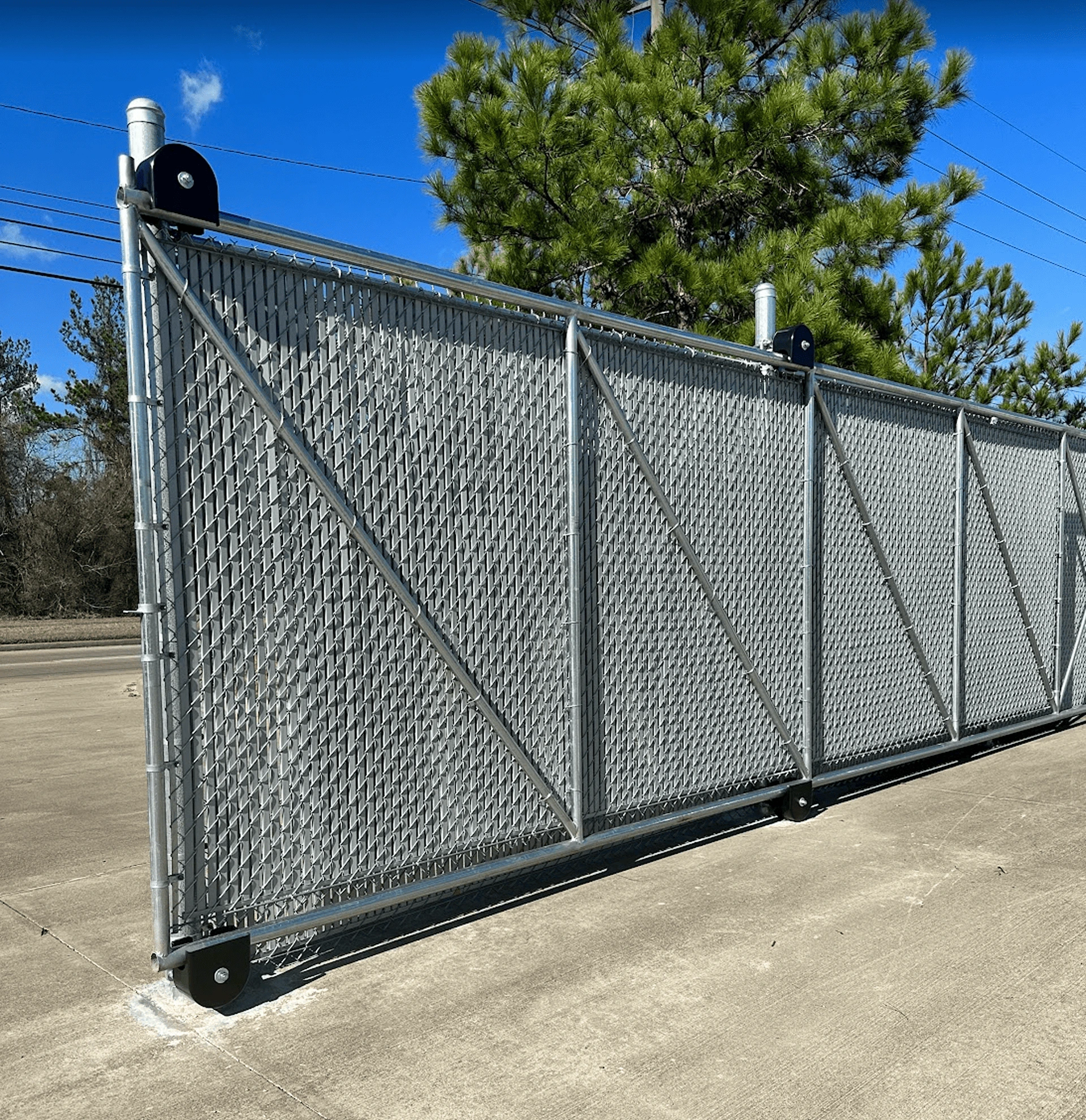
- Cantilever slide gates for heavy traffic and uneven pavement—no ground track to clog.
- Double swing gates for wide openings when you have interior clearance.
- Crash-rated options for sites that need vehicle impact resistance (select areas only).
- Pedestrian access gates to separate foot traffic from trucks.
- Design truck entrances first; everything else can key off that geometry.
- Separate pedestrian entries reduces operational risk and improves access control.
- Plan for power and conduit early if automation is likely later.
Houston code and emergency access: what we plan for on industrial sites
Industrial fencing has to support emergency response, not restrict it. The City of Houston Fire Department’s Life Safety Bureau publishes standards for fire apparatus access roads and fire lanes, including a minimum unobstructed width and vertical clearance in many cases. We review these early so gate locations and turning areas don’t become a last-minute redesign. For the official requirements, see City of Houston Fire Department access road and fire lane requirements.
Practically, this means we pay close attention to:
- Gate clear width and how it opens (and whether it must fail-safe or have emergency override access).
- Truck turning radii and dead-end access roads that may need turnarounds.
- Keeping clear zones free of parked vehicles, storage, or dumpsters.
- Don’t place a “security improvement” that blocks fire lane access.
- Gate design should account for emergency entry and daily operations.
- Early layout review prevents expensive rework late in permitting.
Installation standards and build quality: what separates a security fence from a basic fence
Security performance comes from installation discipline: correct post setting, terminal bracing, tensioning, and proper gate alignment. Industry standards like ASTM chain-link fence installation standard (ASTM F567) outline typical chain-link installation practices (posts, fabric, rails, tension wire, barbed wire, and gates), and we use similar principles to make sure the finished perimeter is tight, straight, and durable.
On Houston projects, we also factor in soil conditions and drainage, because shifting ground and standing water can loosen posts and distort gates over time. We’ll walk the line with you to identify low spots, runoff paths, and any areas where we should increase footing depth or add drainage considerations.
- Strong corners and terminals keep the entire run tight over time.
- A well-hung gate should operate smoothly without sagging or dragging.
- Post setting and drainage details matter in Houston’s wet seasons.
Budgeting: what affects the cost of security fencing for warehouses
Warehouse fencing costs vary widely because the perimeter is only part of the scope. The biggest cost drivers we see are fence height, fabric type, number of gates, automation, and site conditions. If you’re budgeting for the quarter, we recommend thinking in “phases” rather than one huge scope—especially if you need immediate improvements on the most exposed sides first.
Typical cost drivers (what changes your number the fastest)
- Height and topping: taller fence and outriggers require heavier framework and more labor.
- Security fabric: tighter apertures and heavier wire increase material costs.
- Gates: automation, access control, and safety devices can exceed the cost of long fence runs.
- Site prep: clearing vegetation, grading, and removing old fence adds time.
- Concrete and posts: soil and wind exposure can push footing specs higher.
- Gates and automation often dominate the budget more than the fence line.
- Phasing lets you secure priority areas first while planning upgrades.
- Site prep surprises are common—walk the line before final budgeting.
How we typically approach a warehouse security fence project (our recommended workflow)
- Site walk and risk review: identify breach points, blind spots, and traffic flow.
- Layout + gate plan: decide where vehicles and pedestrians should enter.
- Security options: choose height, fabric, topping, and upgrades for each run.
- Access and compliance check: verify fire lane access needs and operational constraints.
- Install + final walk-through: test gates, latches, and access control interfaces.
If financing helps you move faster on security improvements, see our Financing options—we can often phase work while keeping the perimeter functional.
- Security fencing works best when planned with operations, not separately.
- Phased builds can reduce downtime and spread budget impact.
- Final testing should include gate cycles, latch checks, and access control behavior.
FAQ: security fencing for Houston, TX warehouses
What height security fence is typical for a warehouse?
Many industrial sites use taller fencing than residential projects, but the right height depends on your risk level, visibility, and what you’re protecting. We usually evaluate height together with mesh type and topping, because those features work as a system.
Is chain link secure enough for an industrial property?
It can be—when it’s commercial grade and paired with the right upgrades. Security depends on framework strength, tight fabric, strong terminals, and robust gates. We often improve an existing chain link line by upgrading gates and adding anti-climb features where needed.
Can we add access control to an existing gate?
In many cases, yes. The key is whether the gate frame, hinges, and operator mounting points are in good shape. We’ll assess whether it’s better to retrofit or replace so the access control system isn’t fighting mechanical issues.
How long does a commercial security fence install take?
Timelines depend on linear footage, number of gates, and site prep. For many warehouse perimeters, we can complete installation in a few weeks once materials and layout are finalized—especially if we phase work to keep traffic moving.
Get a security fence quote for your Houston, TX warehouse
Whether you need a new perimeter, better gates, or a targeted anti-climb upgrade, we’ll help you design a practical solution that fits operations and budget.
Call Griffin Fence today at (713) 937-6611 or contact us online for a free estimate.
For long-term peace of mind, ask about workmanship coverage and materials—our Warranty page outlines what we stand behind.