Why Houston Businesses Choose Chain Link Fence With Barbed Wire
In Houston, TX, perimeter security is serious business. Warehouses along the Ship Channel, construction sites in the Energy Corridor, equipment yards in Pasadena, and industrial facilities across Harris County rely on chain link fence with barbed wire to keep unauthorized people out and expensive assets in. When a standard chain link fence isn’t enough, adding barbed wire topping transforms an ordinary security fence into a serious deterrent that signals — clearly and unmistakably — that trespassers are not welcome.
At Griffin Fence, we’ve been installing chain link fences with barbed wire extensions across the Greater Houston area for over 25 years. We know the local regulations, the best materials for Houston’s hot and humid climate, and the installation methods that hold up year after year. This guide covers everything you need to know: the types of barbed wire and arm extensions available, Houston and Harris County regulations, real installed costs, and the applications where barbed wire topping delivers the most value.
- Barbed wire topping adds $2–$5 per linear foot to standard chain link fence costs
- Razor wire costs $15–$30 per linear foot installed, significantly more than traditional barbed wire
- Houston, TX generally permits barbed wire on commercial and industrial properties but restricts its use in residential zones
- 45-degree extension arms are the most common arm type for commercial installations in Houston
- Professional installation is required for razor/concertina wire due to serious injury risk
Types of Barbed Wire for Chain Link Fences
Not all barbed wire is the same. The right product depends on your security requirements, budget, and local regulations. Understanding the differences helps you make an informed decision before we visit your property for a free estimate.
Traditional Barbed Wire — 2-Point and 4-Point
Standard barbed wire consists of two or more twisted strands of galvanized steel wire with sharp barbs twisted at regular intervals. It comes in two main configurations for commercial security applications:
2-Point barbed wire has two sharp points per barb cluster spaced about 4 inches apart. It’s the lighter, more economical option and adequate for many commercial fencing applications where the primary goal is deterrence rather than high-security containment. Material cost is lower, and it’s easier to install with standard fencing equipment.
4-Point barbed wire has four points per cluster and is significantly more aggressive. The additional points make climbing or cutting through the wire far more difficult and painful. Most Houston security fence installations use 4-point barbed wire when traditional barbed wire is specified — it provides meaningfully better deterrence without jumping to the much higher cost of razor wire.
Both types are typically available in 12.5-gauge galvanized steel for standard applications or 15.5-gauge for lighter-duty use. For Houston’s coastal humidity environment, high-tensile galvanized wire with Class 3 zinc coating is the preferred spec — it resists rust significantly longer than Class 1 coating.
- 2-point barbed wire: economical, good for general deterrence on commercial properties
- 4-point barbed wire: more aggressive, better security, marginal price increase over 2-point
- Class 3 zinc coating recommended for Houston, TX due to humidity and salt air near the coast
- Standard strands run 1,320 feet per roll; most installations use 3 strands on 45-degree arms
Razor Wire and Concertina Wire
Razor wire — also called concertina wire or barbed tape — is a significantly more aggressive security product than traditional barbed wire. Instead of pointed barbs, razor wire features sharp stamped-metal blades (called “barbs”) crimped onto a high-tensile wire core. The blades are designed to catch and lacerate clothing, skin, and any material that contacts them.
Flat wrap razor wire is installed in a single straight strand along extension arms or fence tops. It’s less coiled and visually similar to barbed wire from a distance, but its razor-sharp blades are far more effective at preventing climbing.
Concertina coils are pre-formed spiral coils, typically 24 to 36 inches in diameter, that are deployed along fence tops or in multiple layers in front of fences. Single coil, double coil, and cross-coil configurations are available depending on the security level required. A single coil expands to about 50 feet in length and creates a formidable barrier that is extremely difficult to breach without heavy-duty tools.
Razor wire is standard in high-security applications: detention facilities, military perimeters, power substations, data centers with outdoor perimeters, and critical infrastructure protection. In commercial Houston applications, we see it most often at scrap yards, recycling facilities, chemical storage yards, and high-value equipment storage.
Important safety note: Razor and concertina wire installation is not a DIY project. The material causes severe lacerations and must be handled with heavy leather gloves and protective clothing. Professional installation by an experienced contractor like Griffin Fence is required for safe deployment.
- Razor wire blades are far more aggressive than barbed wire points — designed to lacerate, not just deter
- Concertina coils expand to 50 feet; multiple coil configurations increase security level significantly
- Razor wire is used in detention facilities, substations, scrap yards, and critical infrastructure
- Professional installation required — DIY razor wire handling causes serious injury
- Cost is $15–$30 per linear foot installed, compared to $2–$5 for traditional barbed wire
Extension Arm Types — 45-Degree, V-Arms, and Straight Arms
The extension arm is the bracket mounted to the top of fence posts that holds barbed wire strands above the fence line. The angle and configuration of the arm determines how effective the barbed wire topping is at preventing climbing.
45-Degree Extension Arms
The 45-degree extension arm is the most common type used in commercial chain link fence installations across Houston. The arm projects outward from the top of the fence post at a 45-degree angle, typically angled toward the outside of the secured property. Three strands of barbed wire are run from arm to arm along the fence line.
The outward angle creates a significant climbing obstacle — a person attempting to scale the fence would need to reach over or around the angled wire array while also managing the vertical fence surface below. Most fence climbers cannot clear this configuration without specialized equipment or tools. For the vast majority of commercial security applications in Houston, 45-degree arms with three strands of 4-point barbed wire provide excellent protection at a reasonable cost.
Extension arms are typically 12 to 18 inches in length (measured from post to wire attachment point) and are fabricated from galvanized steel to match the fence system. They bolt or clamp to standard 1-3/8″ or 1-5/8″ line posts and terminal posts without modification to the post itself.
V-Arms (Double Extension Arms)
V-arms project outward in two directions simultaneously — one angle toward the outside of the property and one angle toward the inside. This creates a “V” shape at the top of each post. Barbed wire strands run on both sides of the V, making it difficult to approach the fence top from either direction.
V-arms are specified when there is a security concern about people inside the facility (preventing exit as much as entry), or when the fence borders a public area where the security operator needs to demonstrate equal protection from both directions. Correctional facilities, secure animal holding areas, and some military applications use V-arms. They are less common in standard commercial Houston applications but are available when the situation calls for them.
Straight (Vertical) Extension Arms
Straight extension arms project straight up from the fence post top, adding height to the fence without an outward angle. Barbed wire strands run horizontally at the tops of these vertical extensions. This configuration is simpler and sometimes used when local regulations prohibit outward-angling extensions over public sidewalks or rights-of-way.
Straight arms add 12 to 18 inches of effective height to the fence with barbed wire, making the fence harder to scale. However, they are generally considered less effective than 45-degree arms because a determined climber can more easily reach over vertical extensions. In Houston, 45-degree arms are almost universally preferred for new commercial installations.
- 45-degree arms are standard for commercial Houston installations — most cost-effective deterrent configuration
- Three strands of barbed wire on 45-degree arms is the typical specification for warehouses and equipment yards
- V-arms protect from both sides — used in corrections, secure animal facilities, and dual-direction security needs
- Straight arms add height but are less effective than angled arms for preventing climbing
- All arms should be galvanized steel to match the fence system and resist corrosion in Houston’s climate
Houston and Harris County Regulations for Barbed Wire Fences
Before any barbed wire fence installation in Houston, TX, understanding the applicable regulations is essential. Barbed wire is not universally permitted, and the rules vary by property type, zoning designation, and location. Griffin Fence handles the permit research and application process for our clients — but we want you to understand the regulatory landscape before we start.
City of Houston Zoning and Code Requirements
The City of Houston, TX is famously one of the only major American cities without traditional zoning ordinances. However, Houston does enforce Chapter 10 of the Code of Ordinances (Buildings and Structures) and has specific rules about fence construction and security features.
Under Houston’s Code of Ordinances, barbed wire fencing is generally permitted on commercial and industrial properties. The primary restrictions apply to residential properties and fence placements adjacent to public rights-of-way. Specifically:
- Commercial and industrial properties: Barbed wire on top of chain link fence is generally permitted when the fence is at least 6 feet tall and the barbed wire is positioned at or above 8 feet from ground level (including the extension arm height)
- Residential properties: Barbed wire is generally not permitted in residential areas of Houston — homeowners should not install barbed wire on residential property fences
- Adjacent to rights-of-way: Extension arms that project over public sidewalks or rights-of-way may require special approval or must be configured to avoid projecting over the public space
- Height restrictions: Standard residential fences in Houston are limited to 8 feet maximum height; commercial properties may build higher with appropriate permits
It is critical to verify current ordinance requirements before any installation. Houston’s codes can change, and individual neighborhoods may have deed restrictions (enforced through HOA covenants or deed restriction districts) that are stricter than city code. Griffin Fence always pulls the required permits and verifies local restrictions before we begin work.
Harris County Requirements (Unincorporated Areas)
Properties in unincorporated Harris County (outside Houston city limits but within the county) are subject to Harris County regulations rather than City of Houston ordinances. Harris County generally has fewer restrictions on barbed wire fencing for agricultural, commercial, and industrial uses. However, deed restrictions recorded against individual properties can still impose limitations regardless of county rules.
Specific cities and municipalities within Harris County — including Pasadena, Baytown, Deer Park, La Porte, and others — maintain their own ordinances. If your property is in one of these cities, we research their specific requirements as part of our pre-installation process.
Liability Considerations
Beyond code compliance, property owners should consider liability. If a person is injured by barbed wire on your fence — even while trespassing — you may face legal exposure in some circumstances. We recommend consulting with your property insurer and a Texas attorney before installing razor wire or multi-strand concertina systems, particularly on properties with public pedestrian access nearby. Standard commercial barbed wire topping with proper signage (“Warning: Barbed Wire”) is generally well-understood and widely installed in Houston with minimal liability concern when properly permitted.
- Barbed wire is generally permitted on Houston commercial and industrial properties when the fence is 6+ feet tall
- Barbed wire is generally NOT permitted on residential properties in Houston, TX
- Always verify current Houston Code of Ordinances requirements before installation
- Unincorporated Harris County has fewer restrictions but individual cities within the county vary
- Post “Warning: Barbed Wire” signage as part of every installation for liability protection
- Griffin Fence handles permit research and applications for all barbed wire fence installations
Installed Cost — Chain Link Fence With Barbed Wire in Houston
Understanding real cost is critical for budgeting a commercial security fence project. Here we break down what you should actually expect to pay for a chain link fence installation with barbed wire topping in the Houston, TX area.
Base Chain Link Fence Cost
Commercial chain link fence in Houston typically runs $12–$25 per linear foot installed, depending on gauge, height, and site conditions. A standard 6-foot commercial chain link fence with 9-gauge mesh on 1-5/8″ line posts at 10-foot spacing is the benchmark specification for most Houston commercial and industrial applications. That base installation falls in the $14–$18 per linear foot range for most standard sites.
Higher security specifications — heavier gauge mesh (6-gauge), larger framework (2″ or 2-1/2″ line posts), deeper post concrete footings — increase the base cost. Difficult site conditions (hard caliche soil, uneven grade, rocky terrain, or access constraints) also add to cost.
Barbed Wire Addition Cost
Adding traditional barbed wire topping (three strands on 45-degree extension arms) typically adds $2–$5 per linear foot to the base fence cost. This covers the cost of the extension arms, barbed wire material, and the labor to install the wire and tension it properly. At 1,000 linear feet, that’s an additional $2,000–$5,000 for barbed wire — a relatively modest investment for the security benefit provided.
The specific cost within that range depends on:
- Barbed wire type (2-point vs. 4-point; Class 3 coated vs. standard)
- Number of strands (single strand adds less than three strands)
- Extension arm type (45-degree vs. V-arm vs. straight)
- Site access and terrain conditions
Razor Wire and Concertina Wire Cost
Razor wire and concertina coil installations cost significantly more than traditional barbed wire. Expect $15–$30 per linear foot installed for razor wire topping. The much higher cost reflects the material cost of the razor wire itself (which is more expensive than barbed wire), the labor-intensive installation process requiring specialized protective equipment, and the additional safety precautions required during deployment.
Concertina coil systems deployed in multiple coil configurations (double or triple coil on ground anchors in addition to fence topping) can run $40–$60 per linear foot for full high-security perimeter installations. These are typically found only in the highest-security commercial or industrial applications.
Complete Project Cost Examples
To put numbers in context for common Houston commercial projects:
- Small warehouse yard (500 LF, 6-foot chain link + 3-strand barbed wire): $8,000–$11,500 total installed
- Construction site enclosure (1,000 LF, 6-foot chain link + 3-strand barbed wire): $16,000–$23,000 total installed
- Industrial facility perimeter (2,500 LF, 8-foot chain link + razor wire topping): $60,000–$95,000 total installed
- Equipment storage yard (750 LF, 6-foot chain link + V-arm barbed wire): $14,000–$19,000 total installed
These are realistic ranges for Houston, TX, not lowball estimates. Be skeptical of quotes that come in significantly below these figures — they often indicate lighter-gauge materials or shortcuts that will cost you more in repairs or replacements within a few years.
Security Applications — Where Barbed Wire Chain Link Fencing Is Used in Houston
Chain link fence with barbed wire serves a specific purpose: it creates a perimeter security solution that is cost-effective, highly visible as a deterrent, and robust enough for serious commercial use. Here are the most common applications we install across the Houston metro area.
Warehouse and Distribution Facilities
Houston is a major logistics hub with hundreds of warehouse and distribution facilities throughout Harris County and surrounding areas. Warehouses storing electronics, automotive parts, consumer goods, and other high-value inventory are frequent targets for cargo theft — a serious problem in the Houston area. A commercial fence company like Griffin Fence installs chain link perimeter fencing with barbed wire topping to secure loading dock areas, outdoor storage yards, and trailer parking lots where unsecured freight is particularly vulnerable.
Construction Sites
Construction sites in Houston suffer significant losses from equipment theft and vandalism. Bulldozers, generators, copper wire, HVAC equipment, and building materials are all targets. A properly installed 6-foot chain link fence with barbed wire topping around the site perimeter dramatically reduces unauthorized entry, especially during non-working hours and weekends when the site is unoccupied. We install both temporary and permanent chain link fence Houston solutions for construction projects ranging from single-family homes to large commercial builds.
Industrial Yards and Manufacturing Facilities
Chemical plants, oil and gas facilities, fabrication yards, and manufacturing operations throughout the Houston industrial corridor require serious perimeter security. Beyond general theft deterrence, these facilities often have safety requirements that demand controlled access to prevent unauthorized individuals from entering hazardous areas. Chain link with barbed wire — and often with integrated access control systems — provides the first line of physical security for these operations.
Equipment and Vehicle Storage
Fleet vehicles, heavy equipment, and construction machinery parked outdoors overnight are vulnerable without proper perimeter security. Fenced equipment yards with barbed wire topping are standard practice for Houston-area contractors, landscaping companies, utility service providers, and equipment rental businesses. The visible deterrent of barbed wire significantly reduces opportunistic theft compared to standard fencing alone.
Scrap Yards and Recycling Facilities
Metal scrap yards and recycling facilities in Houston deal with a persistent theft problem — people attempting to steal metal to resell. These facilities virtually universally use heavy-gauge chain link with razor wire or multi-strand barbed wire. The combination of heavy fence, aggressive wire topping, and security lighting creates a perimeter that is practically impossible to breach without significant noise and risk.
Schools and Public Facilities
Some public facilities — including certain school campuses, utility substations, and government storage yards — use barbed wire chain link fencing in areas where public access is restricted for safety reasons. Applications where the fence separates a public-facing area from a secure operational zone are common.
- Warehouse perimeters and loading dock security are among the most common Houston barbed wire fence applications
- Construction sites use barbed wire chain link to prevent equipment theft during nights and weekends
- Industrial facilities throughout the Houston Ship Channel corridor rely on barbed wire security fencing
- Equipment storage yards for contractors, landscapers, and utility companies are ideal barbed wire fence applications
- Scrap yards and recycling facilities typically use the most aggressive wire configurations (razor wire, multiple strands)
Installation Process — How Griffin Fence Installs Barbed Wire Chain Link
Professional installation of chain link fence with barbed wire follows a systematic process. Understanding what’s involved helps you know what to expect when you hire Griffin Fence for your Houston security fence project.
Site Assessment and Layout
Before we pull a single post, we walk the property with you to understand the layout, identify obstacles, confirm property lines, and discuss gate locations. We note soil conditions (Houston’s expansive clay soil requires specific post depth and concrete footer specifications to resist movement over time), grade changes, and any underground utilities that require marking. We coordinate Texas811 underground utility locating as required by Texas law before any digging begins.
Post Setting
Terminal posts (corners, ends, and gate posts) are typically set 3 feet deep in concrete footings. Line posts are set at 10-foot intervals, typically 2.5 feet deep in concrete. Houston’s clay soil can heave significantly during wet and dry cycles, so proper depth and concrete footer sizing is critical to long-term fence stability. Posts cure in concrete for 24–48 hours before we begin stretching fabric and attaching framework.
Fence Fabric and Framework Installation
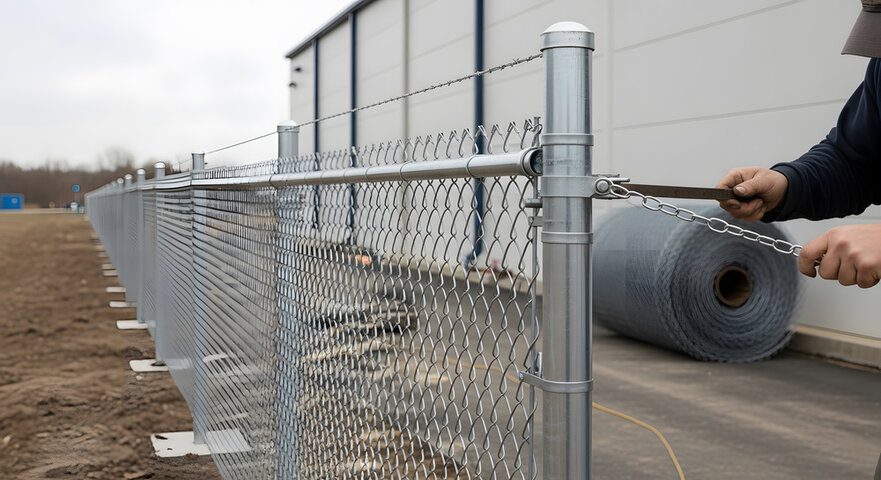
Top rail is run through the post caps, and tension wire is attached at the bottom of the fence line. Chain link fabric is rolled out, attached to terminal posts via tension bars and bands, and stretched tight using come-alongs and stretcher bars. Proper tension prevents fabric sag and the fence shifting over time. Tie wire is applied every 24 inches along line posts and every 12 inches on terminal posts.
Extension Arm Installation
Extension arms are installed on every post — both line posts and terminal posts — along the barbed wire run. Arms bolt to posts using U-bolts and are oriented at the correct angle (45 degrees outward for standard commercial installations). The arms must be plumb and aligned; misaligned arms create uneven wire tensioning that compromises the appearance and effectiveness of the installation.
Barbed Wire Stringing and Tensioning
Barbed wire is unrolled carefully from the wire roll and run through the slots or clips on each extension arm, one strand at a time. Wire is tensioned using barbed wire stretchers to achieve consistent tautness without over-tensioning (which can pull arms out of alignment). Three-strand installations run the bottom strand first, then middle, then top. End-post anchoring secures the wire at terminal posts.
For razor wire and concertina coil installations, the process requires specialized handling with heavy leather gauntlets, thick canvas work suits, and careful coordination between team members. We do not allow razor wire installations without full protective equipment and a minimum two-person crew.
Final Inspection and Signage
After installation is complete, we walk the fence line with you to inspect for any issues. We confirm proper tensioning, arm alignment, gate operation, and barbed wire integrity. We also install required warning signage (“Warning: Barbed Wire” or “Warning: Razor Wire”) at appropriate intervals as required by law and best practice.
Maintaining Your Chain Link Fence With Barbed Wire in Houston, TX
Houston’s climate — high humidity, occasional flooding, salt air in coastal areas, and intense summer heat — accelerates corrosion on metal fencing systems. Proper maintenance extends the life of your investment significantly.
Annual inspection of the entire fence perimeter is recommended. Check for:
- Rust or corrosion developing at post bases (the ground-soil interface is most vulnerable)
- Loose or missing tie wires allowing fabric to sag
- Bent or damaged extension arms that have shifted out of alignment
- Broken barbed wire strands or sections of missing wire
- Gate hardware wear — hinges, latches, and closers should operate smoothly
- Post-flood inspection after major rain events to check for undermining or sediment buildup
For galvanized fencing, a rust-inhibiting paint or coating applied to surface rust spots stops further corrosion. For vinyl-coated chain link, inspect the vinyl coating for cracking or peeling — particularly at connection points — and address damaged areas promptly before moisture penetrates to the steel core beneath.
Contact fence installation Houston specialists at Griffin Fence for annual maintenance inspections. We can identify issues before they become costly repairs.
Frequently Asked Questions — Chain Link Fence With Barbed Wire in Houston
Is barbed wire fence legal on my commercial property in Houston, TX?
In most cases, yes. Barbed wire topping on chain link fences is generally permitted on commercial and industrial properties in Houston, TX, provided the base fence meets minimum height requirements (typically 6 feet or more) and the barbed wire installation complies with local ordinances. Barbed wire is generally not permitted on residential properties. Because regulations vary by property type, zoning designation, and location within Harris County, we strongly recommend verifying current requirements before installation. Griffin Fence researches permit requirements and handles the permit application process for all commercial barbed wire fence installations.
How many strands of barbed wire should I use on my security fence?
Three strands is the standard specification for commercial chain link fence security applications in Houston. Three strands on 45-degree extension arms (typically spaced 6 inches apart vertically on the arm) provides effective deterrence against climbing. Single-strand installations are technically less effective but sometimes used in lower-security situations or where cost is the primary constraint. For higher-security applications, five or more strands, V-arm configurations, or upgrading to razor wire provides additional protection. We discuss the appropriate specification for your specific security needs during our site assessment.
What is the difference between barbed wire and razor wire for a chain link fence?
Barbed wire consists of twisted steel strands with sharp points (barbs) designed primarily as a deterrent — it causes discomfort and snags clothing. Razor wire (concertina wire) features sharp stamped-metal blades on a high-tensile core that are designed to cause serious lacerations. Razor wire is significantly more aggressive, more expensive ($15–$30 per linear foot versus $2–$5 for barbed wire), and requires professional installation due to serious injury risk during handling. For most standard commercial applications in Houston — warehouses, equipment yards, construction sites — traditional 4-point barbed wire provides excellent security at a much lower cost than razor wire. Razor wire is typically reserved for the highest-security installations.
How long does a chain link fence with barbed wire last in Houston’s climate?
A properly installed, commercial-grade galvanized chain link fence with galvanized barbed wire in Houston, TX can last 20–30 years with proper maintenance. The primary enemy is corrosion — Houston’s humidity accelerates rust on galvanized steel, particularly in coastal areas (within 50 miles of the Gulf) where salt air is a factor. Specifying Class 3 zinc-coated galvanized chain link and barbed wire instead of Class 1 significantly extends service life. Vinyl-coated chain link provides an additional layer of corrosion protection. Annual inspections and prompt treatment of surface rust at ground-contact points are the most important maintenance steps for maximizing fence longevity.
Get a Free Estimate on Chain Link Fence With Barbed Wire in Houston
Griffin Fence has installed chain link fence with barbed wire at hundreds of commercial and industrial properties across the Houston metro area. We understand the security requirements of Houston businesses, the regulatory landscape, and the material specifications that hold up in our climate. Our process is straightforward: we visit your site, assess your security needs, verify applicable regulations, and provide a detailed written estimate with no hidden costs.
Call Griffin Fence today at (713) 937-6611 or contact us online for a free estimate. Our team serves the entire Greater Houston area including Harris County, Fort Bend County, Brazoria County, Montgomery County, and Galveston County.